The Rapture: What Is the Rapture and What Does the Bible Say About It?
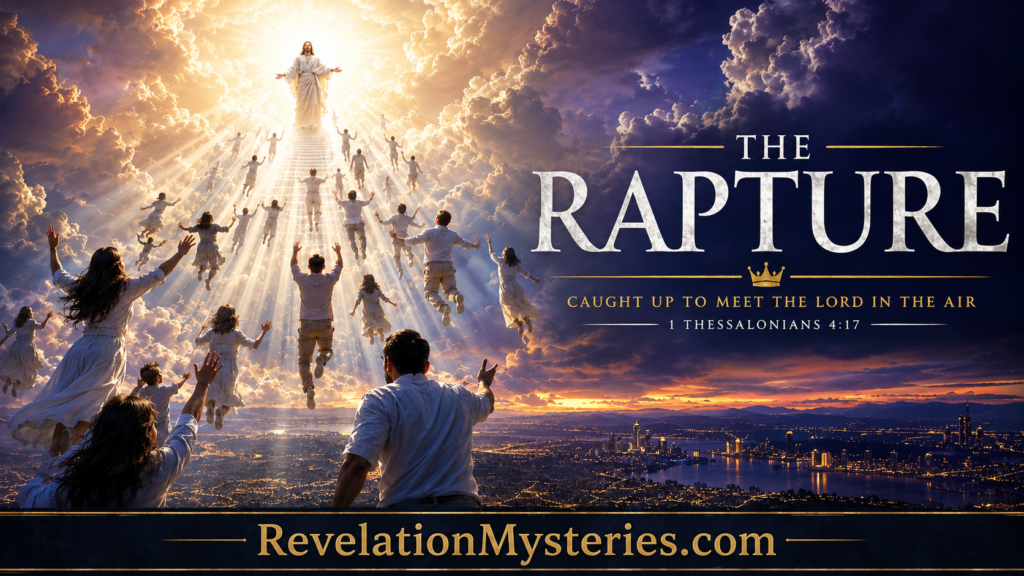
What is the Rapture? When will the Rapture happen? Does the Bible teach a pre-tribulation Rapture? What happens to Christians when the Rapture occurs? These are some of the most important questions surrounding Bible prophecy and the end times.
The Rapture is the biblical event in which Jesus Christ gathers His followers to Himself. The apostle Paul describes believers being caught up to meet the Lord in the air, while Jesus promised that He would come again for His people.
The Rapture is one of the most discussed subjects in Christian eschatology, end-times prophecy, Bible prophecy, and the study of the Book of Revelation. Christians have different views about exactly when the Rapture will occur, but the central hope is clear: Jesus Christ is coming again, and those who belong to Him will be with Him.
This comprehensive guide examines what the Bible says about the Rapture, the major Rapture views, important Bible verses about the Rapture, the relationship between the Rapture and the Tribulation, and how the Rapture relates to the Second Coming of Jesus Christ.
What Is the Rapture?
The word “Rapture” does not appear as an English word in most English translations of the Bible. The concept, however, comes directly from biblical teaching.
The central passage describing the Rapture is 1 Thessalonians 4:13–18. Paul explains that when Jesus returns, believers who have died will be raised, and living believers will be caught up together with them to meet the Lord in the air.
Paul writes:
“Then we who are alive, who are left, will be caught up together with them in the clouds to meet the Lord in the air.” — 1 Thessalonians 4:17 ESV
The phrase “caught up” is particularly important. It describes the supernatural gathering of believers to Christ.
The Rapture therefore refers to the future event when Jesus Christ gathers His Church to Himself, transforming believers and bringing them into His presence.
The Rapture is not merely a symbolic picture of spiritual renewal. Scripture presents it as a real future event involving the resurrection of deceased believers and the transformation and gathering of living believers.
What Happens at the Rapture?
According to 1 Thessalonians 4:13–18 and 1 Corinthians 15:51–52, several important things happen at the Rapture.
1. Jesus comes for His people
The Rapture is centered on the return of Jesus Christ.
Paul says:
“For the Lord himself will descend from heaven with a cry of command.” — 1 Thessalonians 4:16 ESV
The Rapture is therefore not about humanity finding its own way to God. Jesus is the one who comes for His people.
2. Believers who have died are resurrected
Christians who have died are not forgotten.
Paul teaches that:
“the dead in Christ will rise first.”
The resurrection of believers is an essential part of the Rapture.
3. Living believers are caught up
After the dead in Christ are raised, Christians who are alive at that time will be caught up together with them.
This is the event commonly called the Rapture of the Church.
4. Believers meet Jesus in the air
Paul says believers will:
“meet the Lord in the air.”
The destination is ultimately being with Christ.
5. Believers will always be with the Lord
This is perhaps the most encouraging part of Paul's teaching:
“and so we will always be with the Lord.” — 1 Thessalonians 4:17 ESV
The ultimate hope of the Rapture is not simply escaping earthly circumstances.
The ultimate hope is Jesus.
Key Bible Verses About the Rapture
Several passages are especially important when studying the Rapture.
1 Thessalonians 4:13–18
This is the primary passage describing believers being caught up to meet Jesus.
Paul's purpose is also pastoral. The Thessalonian Christians were concerned about believers who had already died. Paul explains that Christians have hope because death does not separate believers from Christ forever.
1 Corinthians 15:51–52
Paul reveals a mystery concerning the resurrection:
“We shall not all sleep, but we shall all be changed.”
He explains that this transformation will happen suddenly:
“in the twinkling of an eye.”
This passage is especially important for understanding the transformation of living believers.
John 14:1–3
Before His crucifixion, Jesus told His disciples that He was going to prepare a place for them and promised:
“I will come again and will take you to myself.”
Many Christians understand this promise as being connected with Christ's gathering of His people.
Philippians 3:20–21
Paul teaches that believers are awaiting the Savior from heaven and that Jesus will transform their lowly bodies to be like His glorious body.
This points toward the future resurrection and transformation of believers.
Titus 2:13
Paul describes Christians as:
“waiting for our blessed hope, the appearing of the glory of our great God and Savior Jesus Christ.”
The return of Jesus is therefore presented as the believer's blessed hope.
Matthew 24:36–44
Jesus repeatedly emphasizes the unexpected nature of His coming and instructs His followers to remain watchful.
This passage is important when studying Rapture readiness, Christ's return, and end-times watchfulness.
Is the Rapture in the Bible?
Yes, although the specific English word “Rapture” is not used in most English Bible translations.
The doctrine comes primarily from passages teaching that:
- Christ will come for His people.
- The dead in Christ will be resurrected.
- Living believers will be transformed.
- Believers will be caught up to meet Christ.
- Believers will forever be with the Lord.
The expression “caught up” in 1 Thessalonians 4:17 is the foundation for the term Rapture.
The biblical teaching should therefore be evaluated based on the passages themselves rather than simply whether the word “Rapture” appears in an English Bible.
When Will the Rapture Happen?
One of the biggest questions in Bible prophecy is when the Rapture will occur.
Christians have developed several major interpretations.
The three most commonly discussed positions are:
- Pre-Tribulation Rapture
- Mid-Tribulation Rapture
- Post-Tribulation Rapture
Other views, including pre-wrath and partial-Rapture interpretations, are also discussed among Christians.
The important thing is to distinguish between what Scripture clearly teaches and where faithful Christians disagree about prophetic timing.
What Is the Pre-Tribulation Rapture?
The pre-tribulation Rapture view teaches that the Rapture will occur before the seven-year Tribulation period commonly associated with Daniel's seventieth week.
According to this interpretation, Christ first gathers His Church to Himself. The Tribulation then begins, eventually leading to the Second Coming of Christ.
A commonly proposed end-times sequence is:
Rapture → Tribulation → Second Coming → Millennial Kingdom
Those who hold this view often emphasize passages concerning the Church's deliverance from coming wrath and the distinction between the Rapture and Christ's visible return to earth.
The pre-tribulation position is one of the most widely recognized interpretations of end-times prophecy, particularly within evangelical Christianity.
In Unraveling The Mysteries of the Book Of Revelation I present Biblical evidence for the pre tribulation rapture. And why I believe that it is most consistent with what God's word says about the rapture.
What Is the Mid-Tribulation Rapture?
The mid-tribulation Rapture view places the Rapture around the middle of the Tribulation period.
In this interpretation, Christians experience part of the Tribulation before being gathered to Christ.
The exact details of mid-Tribulation interpretations vary, and not everyone who holds this position understands the prophetic timeline in precisely the same way.
What Is the Post-Tribulation Rapture?
The post-tribulation Rapture view teaches that the Rapture occurs at or near the end of the Tribulation, in connection with Christ's visible Second Coming.
According to this interpretation, believers remain on earth through the Tribulation and are gathered to Christ when He returns.
One of the major questions in this discussion is whether the Bible describes one event or two distinct aspects of Christ's future coming.
Rapture vs. Second Coming: Are They the Same Event?
The Rapture and the Second Coming of Jesus are closely related, but many Christians understand them as distinct events.
The Rapture passages emphasize believers being caught up to meet Christ in the air.
The Second Coming passages emphasize Christ's visible return in glory and His coming to judge and reign.
For example, Revelation 19 describes Jesus appearing as the victorious King who defeats His enemies.
This creates an important distinction in many end-times models:
The Rapture
- Christ gathers His followers.
- Believers meet Him in the air.
- The dead in Christ are resurrected.
- Living believers are transformed.
- The focus is on Christ gathering His people.
The Second Coming
- Christ returns in visible glory.
- Christ comes as King and Judge.
- His enemies are defeated.
- Christ establishes His righteous reign.
- The event is associated with the climax of end-times judgment.
The exact relationship between these events is one of the major subjects of Christian eschatology.
Rapture and the Tribulation
The relationship between the Rapture and the Tribulation is one of the most debated questions in Bible prophecy.
Jesus spoke extensively about future tribulation in Matthew 24.
The Book of Revelation also describes a series of judgments involving:
- The seven seals
- The seven trumpets
- The seven bowls
- The rise of the Antichrist
- Worldwide conflict
- Persecution
- Divine judgment
- The Battle of Armageddon
- The return of Jesus Christ
The question is whether the Church will be present during some or all of these events.
Different Christian interpretations answer this question differently.
A careful study should therefore distinguish between biblical facts, interpretations of prophetic passages, and theological conclusions about the timing of the Rapture.
Will Christians Go Through the Tribulation?
This question cannot be answered without addressing the different Rapture positions.
Pre-Tribulation View
Christians are removed before the Tribulation begins.
Mid-Tribulation View
Christians experience the first part of the Tribulation before the Rapture.
Post-Tribulation View
Christians remain through the Tribulation and are gathered to Christ in connection with His Second Coming.
Pre-Wrath View
The Rapture occurs before the final outpouring of God's wrath, while believers may experience some earlier Tribulation events.
Because sincere Christians hold different positions, it is important to study the relevant passages carefully rather than assuming that every detail of a particular prophetic system is explicitly stated in one passage.
What Are the Signs of the Rapture?
A common search question is “What are the signs of the Rapture?”
The Bible gives numerous signs concerning the return of Christ and the end times, including:
- Deception
- Wars and rumors of wars
- Persecution
- Spiritual deception
- Apostasy
- Increasing lawlessness
- The proclamation of the gospel
- The rise of false teachers
- Events associated with the Tribulation
- The appearance and activity of the Antichrist
- Events described in the Book of Revelation
However, there is an important distinction.
Jesus teaches that no one knows the exact day or hour of His coming.
Therefore, Christians should not attempt to calculate a precise date for the Rapture.
The proper biblical response is watchfulness, faithfulness, and readiness.
Can We Know the Date of the Rapture?
No one should claim to know the exact date of the Rapture.
Jesus said:
“Therefore, stay awake, for you do not know on what day your Lord is coming.” — Matthew 24:42 ESV
The Bible repeatedly emphasizes uncertainty regarding the exact timing.
Attempts to predict a specific date have repeatedly failed.
The biblical emphasis is not on calculating the date but on living faithfully while waiting for Christ.
Why Is the Rapture Important?
The Rapture matters because it is connected to some of the greatest promises in the New Testament.
The Rapture Gives Christians Hope
Paul introduced his teaching about the Rapture specifically to encourage believers.
After describing the resurrection and catching up of believers, Paul says:
“Therefore encourage one another with these words.” — 1 Thessalonians 4:18 ESV
The Rapture is therefore meant to produce hope rather than fear.
The Rapture Reminds Us That Jesus Is Coming Again
Christianity is built around the historical death and resurrection of Jesus and the promise of His return.
The Rapture reminds believers that the story has not ended.
The Rapture Points to the Resurrection
Death is not the final destiny of those who belong to Christ.
The resurrection is central to Christian hope.
The Rapture Calls Christians to Be Ready
Jesus repeatedly instructed His followers to watch and remain spiritually prepared.
Rapture and the Church
The Church plays an important role in many interpretations of end-times prophecy.
The New Testament teaches that believers are members of Christ's body and are united with Him.
The Rapture is therefore understood by many Christians as the future gathering of the Church to Jesus.
The timing of that gathering in relation to the Tribulation remains a matter of interpretation.
This is one reason the study of the Rapture, the Church, the Tribulation, Daniel's seventieth week, and the Second Coming should be done together rather than as isolated topics.
Rapture and the Antichrist
The Antichrist is one of the central figures in many interpretations of end-times prophecy.
The New Testament describes the coming of lawlessness and opposition to God, while Revelation describes the Beast and his role in the final conflict.
One of the major prophetic questions is whether the Antichrist will be revealed before or after the Rapture.
Pre-Tribulation interpreters generally expect the Church to be removed before the Antichrist's full rise to power during the Tribulation.
Other interpretations understand the Church's presence and the revelation of the Antichrist differently.
The important point is that the Bible's focus is ultimately not the Antichrist.
The focus is Jesus Christ.
The Antichrist represents rebellion against God, while Jesus is the victorious King who ultimately defeats His enemies.
Rapture and the Book of Revelation
The Book of Revelation does not use the word “Rapture” as a technical term.
Nevertheless, many Christians connect Revelation's prophetic timeline with passages about the Rapture.
Revelation describes:
- God's throne
- The Lamb
- The seven seals
- The four horsemen of the Apocalypse
- The 144,000
- The seven trumpets
- The two witnesses
- The Beast
- The Antichrist
- The mark of the Beast
- Babylon
- The seven bowls
- Armageddon
- The Second Coming
- The Millennial Kingdom
- The Great White Throne Judgment
- The New Heaven and New Earth
- The New Jerusalem
Understanding how these events relate to the Rapture requires comparing Revelation with passages from Matthew, Daniel, 1 Thessalonians, 1 Corinthians, 2 Thessalonians, and other prophetic passages.
Rapture and the Resurrection
The Rapture cannot be separated from the biblical teaching about resurrection.
Paul says:
“the dead will be raised imperishable, and we shall be changed.” — 1 Corinthians 15:52 ESV
Christian hope is not based on escaping death simply to continue ordinary earthly existence.
It is based on resurrection, transformation, and eternal life with Christ.
The Rapture therefore points toward one of the central promises of Christianity:
Jesus will ultimately defeat death.
What Happens to Christians After the Rapture?
The Bible teaches that believers will be with Christ.
Paul concludes his teaching about the Rapture with the words:
“and so we will always be with the Lord.”
The ultimate future of Christians includes fellowship with God, resurrection life, and participation in the eternal kingdom of God.
The Bible's final vision is not simply about escaping the earth.
Revelation 21–22 describes the New Heaven and New Earth, the New Jerusalem, the presence of God, and the removal of death, mourning, crying, and pain.
The story of biblical prophecy ultimately ends with God dwelling with His people.
How Should Christians Prepare for the Rapture?
The Bible does not tell Christians to prepare by predicting a date.
Instead, Scripture emphasizes spiritual readiness.
1. Know Jesus Christ
The most important preparation is having a genuine relationship with Jesus Christ.
2. Trust the Gospel
Salvation is found through Jesus Christ, His death for our sins, and His resurrection.
3. Remain Watchful
Jesus repeatedly tells His followers to remain awake and prepared.
4. Live Faithfully
Christians are called to follow Christ regardless of what happens in the world.
5. Study Scripture
Understanding Bible prophecy requires knowing the larger biblical story rather than relying only on headlines or speculation.
6. Encourage Other Believers
Paul specifically says that the teaching about Christ's coming should encourage believers.
7. Share the Gospel
The expectation of Christ's return should motivate Christians to make Jesus known.
Common Questions About the Rapture
Is the Rapture real?
Christians who believe in the Rapture understand it as a future event taught through passages such as 1 Thessalonians 4:13–18 and 1 Corinthians 15:51–52.
Does the Bible say the word Rapture?
The English word “Rapture” does not appear in most English translations. The doctrine comes from the biblical expression that believers will be “caught up” to meet the Lord.
When is the Rapture?
The exact timing is debated. Major views include pre-Tribulation, mid-Tribulation, post-Tribulation, and pre-wrath interpretations.
Is the Rapture before the Tribulation?
The pre-Tribulation Rapture view says yes. Other Christian interpretations place the Rapture later.
Is the Rapture the Second Coming?
Many Christians understand the Rapture and Second Coming as distinct events, while others understand them as different aspects of one future coming of Christ.
Will the dead be raised at the Rapture?
Yes. 1 Thessalonians 4 teaches that the dead in Christ will rise first.
Will living Christians be changed?
Yes. 1 Corinthians 15 teaches that believers will be changed and given imperishable bodies.
Can the date of the Rapture be predicted?
No. Jesus instructed His followers to remain watchful rather than giving them a date to calculate.
What Bible verse talks about the Rapture?
The most direct passage is 1 Thessalonians 4:13–18. Another major passage is 1 Corinthians 15:51–52.
Does Revelation mention the Rapture?
Revelation does not explicitly use the term “Rapture.” Interpretations of the Rapture's relationship to Revelation's events vary among Christians.
The Rapture: The Blessed Hope
The Rapture is ultimately not supposed to be a subject of endless speculation.
It is a reminder that Jesus Christ is coming again.
The New Testament calls believers to live with hope, faithfulness, holiness, and expectation.
Whether studying the Rapture, the Tribulation, the Antichrist, the Second Coming, the Millennium, or the final chapters of Revelation, the central message of biblical prophecy remains the same:
Jesus Christ wins.
The Book of Revelation ultimately points beyond judgment to the victory of Christ, the defeat of evil, the resurrection of God's people, and the eternal presence of God with His people.
For Christians, the Rapture is therefore not primarily about escaping the future.
It is about being with Jesus.
Continue Exploring End-Times Prophecy
If you want to understand the Rapture in the larger framework of biblical prophecy, explore these related topics:
- What Is the Tribulation?
- Who Is the Antichrist?
- What Is the Mark of the Beast?
- What Is the Battle of Armageddon?
- What Is the Second Coming of Jesus?
- What Are the Seven Seals in Revelation?
- What Are the Seven Trumpets in Revelation?
- What Are the Seven Bowls of Revelation?
- What Is the Millennium?
- What Is the New Jerusalem?
- What Is the New Heaven and New Earth?
- Book of Revelation Explained
- End Times Prophecy
- Book of Revelation Timeline
Final Thought
The Rapture is one of the most fascinating subjects in Bible prophecy, but the greatest message is not simply that believers will be caught up.
The greatest message is that Jesus is coming for His people.
The Christian response should therefore be one of hope and readiness:
Know Christ. Follow Christ. Trust Christ. Watch for Christ.
And remember the promise of Scripture:
“Therefore encourage one another with these words.” — 1 Thessalonians 4:18 ESV
Continue Studying the Book of Revelation
Continue your study of the Book of Revelation by exploring on revelationmysteries.com:
- Revelation Explained
- Revelation Timeline
- The Seven Trumpets in Revelation
- The Seven Bowls of God’s Wrath
- The Four Horsemen of the Apocalypse
- The 144,000 in Revelation 7
- The Great Multitude in Revelation 7
- The Antichrist in Revelation
- The Beast of Revelation 13
- The Mark of the Beast
- Babylon the Great
- Armageddon
- The Second Coming of Jesus
- The Millennium
- The Great White Throne Judgment
- The New Jerusalem
- The New Heaven and New Earth
The more carefully we study Revelation in its biblical context, the more clearly we see that its ultimate purpose is not to satisfy curiosity about the future.
It is to reveal Jesus Christ and call His people to remain faithful until He comes.
Why Buy Unraveling The Mysteries of the Book Of Revelation?
The Book of Revelation is one of the most fascinating, challenging, and often misunderstood books of the Bible.
Filled with visions, symbols, prophetic events, heavenly scenes, judgments, spiritual warfare, the Antichrist, the beast, Babylon, the return of Jesus Christ, the Millennium, the final judgment, the New Jerusalem, and the new heaven and new earth, Revelation can seem overwhelming when you first begin reading it.
Unraveling The Mysteries of The Book of Revelation by Kevin Bart was written to help readers understand this remarkable book of the Bible in a clear, organized, and accessible way.
Rather than treating Revelation as an impossible mystery, this book examines its major prophecies, symbols, events, and themes while seeking to understand them in light of Scripture.
Answering All Your Questions About Revelation
Since Unraveling The Mysteries of the Book Of Revelation by Kevin Bart is a clear verse-by-verse guide to understanding end times prophecy and Revelation, it answers all of the questions people have.
If you have ever asked questions such as:
- Can the Book of Revelation be explained?
- How should Revelation be interpreted?
- Does the Book Of Revelation have a timeline?
- Who are the 144,000 in Revelation?
- What are the seven seals?
- Who are the 4 horsemen of the Apocalypse?
- What are the seven trumpets?
- What are the seven bowls of God’s wrath?
- Who is the Antichrist?
- What is the mark of the beast?
- Who are the two witnesses?
- What is Babylon in Revelation?
- When will Jesus return?
- What is the Millennium?
- What happens after the final judgment?
- What is the New Heaven & Earth and New Jerusalem?
- What does Revelation say about the end times?
- Why should I buy and read Unraveling The Mysteries of the Book Of Revelation?
then Unraveling The Mysteries of the Book of Revelation was written for you.
Kevin Bart has been a follower of Jesus for over 40 years. Kevin has taught Bible study classes, small groups, and discipleship classes for many years. He developed Pursuing Intimacy With God(opens in new tab) Bible studies website and book after many years of seeking God and studying His word. Kevin and his wife Nancy have 3 sons and 2 precious grandchildren.
Kevin is a former business owner, and current international missions ministry leader with more than four decades of combined business and ministry experience. After building and running a successful business for 23 years, with God’s guidance and blessings, he sold his company to dedicate himself to full-time global missions.
For over 20 years, Kevin and his wife Nancy have led a self funded international missions ministry. Utilizing learned business and financial management skills, as well as knowledge and experience in travel points and miles, to date they have had more than 5o mission trips to 36 countries in the Caribbean, Central America, South America, Europe, Africa, and Asia.
After many years of studying the Bible and the Book of Revelation, and writing many Bible studies and articles, Kevin finally finished Unraveling The Mysteries of the Book Of Revelation(opens in new tab). Hopefully it will be a blessing to many people.