The Antichrist in the Bible: Who Is the Antichrist? A Complete Guide to End Times Prophecy
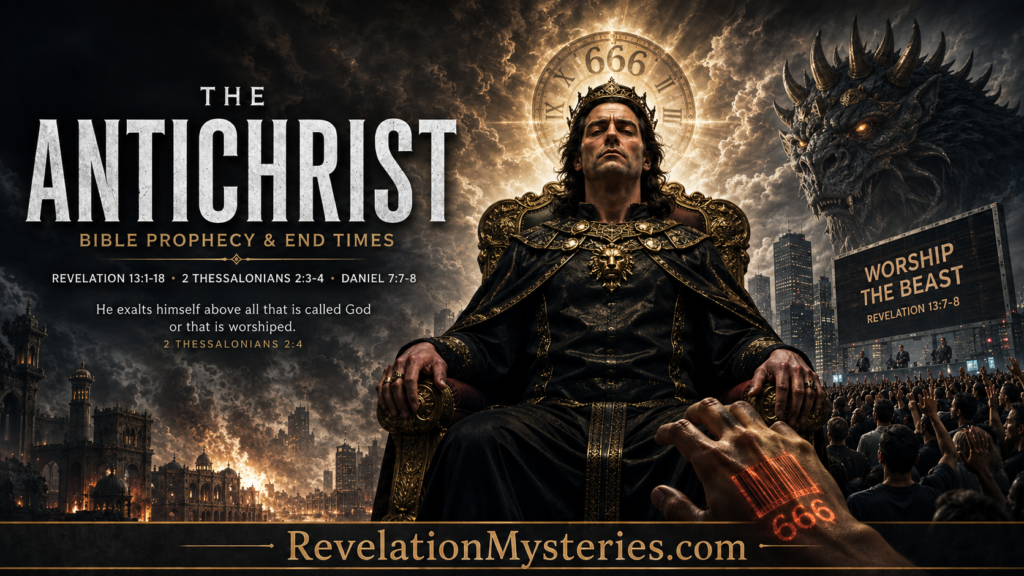
The Antichrist is one of the most mysterious and frequently discussed subjects in Bible prophecy and end times prophecy. Who is the Antichrist? What does the Bible say about his identity, power, kingdom, and ultimate destiny? Is the Antichrist a specific individual who will appear in the last days, or does the term describe a broader spiritual opposition to Jesus Christ?
The Bible provides important clues, but it also leaves some questions unanswered.
This guide examines the major Bible verses about the Antichrist, the Antichrist in Revelation, the beast of Revelation, the man of lawlessness, the little horn in Daniel, the mark of the beast, and the Antichrist's relationship to the final events described in Scripture.
Whether you are studying Revelation, Daniel, 2 Thessalonians, 1 John, or the broader subject of end times prophecy, understanding the Antichrist is an important part of understanding biblical prophecy.
What Is the Antichrist?
The word Antichrist is commonly associated with the final evil ruler described in end times prophecy.
However, there is an important biblical distinction.
The actual word “antichrist” appears specifically in the letters of John. John uses the term to describe those who deny that Jesus is the Christ and those who oppose the truth about Jesus.
At the same time, other biblical books describe a powerful end-times opponent of God using different titles and symbols.
These include:
- The beast
- The man of lawlessness
- The son of destruction
- The little horn
- The king who exalts himself
- The ruler who opposes God
Because these descriptions share important characteristics, many Christians believe they ultimately refer to the same final evil ruler or closely related manifestations of opposition to God.
Understanding these distinctions is important when studying who the Antichrist is according to the Bible.
Who Is the Antichrist According to the Bible?
The Bible does not give us the Antichrist's personal name.
Instead, Scripture provides a collection of characteristics that help us understand his nature, authority, activities, and ultimate destiny.
The Antichrist is generally understood within Christian prophecy as a future figure who will exercise extraordinary political, military, and spiritual influence while opposing God and exalting himself against Jesus Christ.
Several passages are especially important:
- Daniel 7
- Daniel 9
- Daniel 11
- Matthew 24
- 2 Thessalonians 2
- 1 John 2
- 1 John 4
- 2 John 7
- Revelation 13
- Revelation 17
- Revelation 19
When these passages are studied together, they provide a much clearer picture of biblical teaching concerning the final opposition to Christ.
Does the Bible Say the Antichrist Is One Person?
This is an important question.
Some biblical passages clearly describe antichrists in the plural.
For example, 1 John 2:18 says:
“Children, it is the last hour, and as you have heard that antichrist is coming, so now many antichrists have come.”
John therefore recognizes both a coming Antichrist and many antichrists.
This means that the concept of antichrist has both a present spiritual dimension and a possible future individual dimension.
Many Christians understand the future Antichrist as a final individual who will embody and lead the rebellion against God described throughout biblical prophecy.
What Does “Antichrist” Mean?
The Greek term translated antichrist carries the idea of being against Christ or standing in opposition to Christ.
The prefix can also convey the idea of being in the place of or instead of Christ.
This is significant.
The Antichrist is not merely someone who dislikes Christianity.
The biblical concept involves opposition to Jesus Christ and rejection of the truth concerning Him.
The Antichrist represents rebellion against God and ultimately attempts to take a position that belongs to God alone.
Antichrist Bible Verses
Several passages are particularly important when studying the Antichrist.
1 John 2:18
John writes that believers have heard that Antichrist is coming and that many antichrists have already appeared.
This passage establishes both the present and future dimensions of the concept.
1 John 2:22
John connects antichrist with denial that Jesus is the Christ.
1 John 4:3
John refers to the spirit of antichrist that is already in the world.
2 John 7
John again describes deceivers who deny Jesus Christ as having a connection with antichrist.
These passages are foundational for understanding what the word Antichrist actually means in Scripture.
The Antichrist and the Beast of Revelation
One of the most important questions in Revelation studies is:
Is the Antichrist the Beast of Revelation?
Many Christians believe the final Antichrist corresponds to the beast from the sea in Revelation 13.
Revelation 13 describes a beast that receives authority from the dragon, who is identified as Satan.
The beast exercises extraordinary authority and receives worldwide attention.
He is associated with:
- Political power
- Global authority
- Worship
- Blasphemy
- Persecution
- Economic control
- The number 666
- The mark of the beast
- Opposition to God
- War against God's people
Revelation 13 therefore provides one of the most important prophetic portraits of the figure commonly identified as the Antichrist.
The Antichrist and the Beast
The word Antichrist does not actually appear in the book of Revelation.
This is an important detail.
Revelation calls the figure the beast, while John's letters use the term Antichrist.
Nevertheless, many Christians understand the two descriptions as referring to the same end-times ruler because of their remarkable similarities.
The Antichrist is therefore often referred to as the beast of Revelation.
However, when studying prophecy, it is wise to distinguish between what Scripture explicitly says and interpretations that connect passages together.
The Antichrist and the Man of Lawlessness
Another major biblical description appears in 2 Thessalonians 2.
Paul describes a figure called the man of lawlessness.
This individual:
- Opposes God
- Exalts himself
- Places himself above everything called God
- Seeks worship
- Is associated with rebellion
- Is connected with the coming of the Lord
- Is ultimately destroyed by Jesus
Paul writes that the man of lawlessness will exalt himself in God's temple and proclaim himself to be God.
Because of these similarities, many Christians identify the man of lawlessness with the Antichrist.
The passage is one of the strongest biblical descriptions of a final individual who will openly oppose God.
The Antichrist in Daniel
To understand the Antichrist, it is essential to study the book of Daniel.
Daniel contains several prophetic visions concerning kingdoms and rulers who oppose God.
One of the most important passages is Daniel 7.
Daniel sees four beasts representing kingdoms, followed by a particularly significant little horn.
The little horn:
- Speaks arrogant words
- Opposes God
- Persecutes God's people
- Attempts to change appointed times and law
- Exercises authority for a limited period
Many students of Bible prophecy understand the little horn as a prophetic picture of the final Antichrist.
Daniel's prophecy is especially important because Jesus and the New Testament writers build upon many of Daniel's themes.
The Antichrist and Daniel's Seventieth Week
Daniel 9:24–27 contains the famous prophecy commonly called Daniel's seventy weeks or Daniel's seventy sevens.
The final period described in Daniel 9 has become central to many interpretations of end times prophecy.
The passage describes a ruler who makes a covenant for a period of time and later breaks it.
The middle of the final period is associated with the cessation of sacrifice and an abomination of desolation.
Many futurist interpretations connect this ruler with the future Antichrist.
This interpretation is closely connected to theories concerning:
- The Tribulation
- The seven-year Tribulation
- The midpoint of the Tribulation
- The abomination of desolation
- The Antichrist's covenant
- The Second Coming of Jesus
The Antichrist and the Abomination of Desolation
Jesus referred to the abomination of desolation when teaching about future events in Matthew 24.
The phrase has roots in the book of Daniel.
Daniel describes an act of desecration associated with a ruler who opposes God.
Jesus tells His disciples to pay attention to Daniel's prophecy.
Many futurist interpreters believe the final fulfillment will involve the Antichrist's desecration of a future temple or sacred place.
This event is often understood as a major turning point in the end-times timeline.
The Antichrist and the Seven-Year Tribulation
A common interpretation of Daniel's final seven is that it corresponds to a future seven-year Tribulation period.
According to this interpretation, the Antichrist rises to power and makes a covenant or agreement connected with the beginning of this period.
At the midpoint, the Antichrist breaks the covenant and begins an intensified period of persecution and rebellion against God.
This interpretation is particularly common among futurist and dispensational approaches to Revelation.
However, Christians differ significantly on the timing and interpretation of these events.
Some interpret the relevant prophecies differently, while others do not understand Daniel's final seven as a future seven-year Tribulation.
What Will the Antichrist Do?
According to the passages commonly associated with the Antichrist, this ruler will attempt to exercise enormous authority.
His actions include:
1. Opposing God
The Antichrist's central characteristic is rebellion against God.
2. Exalting Himself
He will seek a position of extraordinary authority and honor.
3. Demanding Worship
Revelation 13 describes people worshiping the beast.
4. Persecuting God's People
The beast makes war against the saints.
5. Exercising Political Authority
The beast receives authority over nations and peoples.
6. Controlling Economic Activity
Revelation 13 connects the beast's authority with buying and selling.
7. Blaspheming God
The beast speaks against God and those who belong to Him.
8. Deceiving People
The Antichrist's rise is associated with deception and counterfeit signs.
What Is the Mark of the Beast?
One of the most famous subjects in Revelation is the mark of the beast.
Revelation 13:16–18 describes a mark associated with the beast's authority.
The mark is connected with the ability to buy and sell.
Revelation identifies the number of the beast as 666.
The mark has generated enormous speculation throughout history.
People have associated the mark with everything from:
- Technology
- Identification systems
- Digital currency
- Banking systems
- Government programs
- Microchips
- Artificial intelligence
- Global economic systems
However, Christians should be cautious about declaring that any current technology or political system is definitively the mark of the beast.
The biblical passage describes the mark within a larger prophetic context involving worship of the beast and allegiance to his authority.
The spiritual significance of the mark is therefore at least as important as its physical characteristics.
What Does 666 Mean?
Revelation 13:18 identifies the number of the beast as 666.
The passage calls for wisdom in understanding the number.
Throughout history, many attempts have been made to identify the Antichrist by calculating the numerical value of a person's name.
Some historical figures have been proposed as possible candidates.
However, no identification has been universally accepted, and Christians should be cautious about treating speculative calculations as established biblical facts.
The Bible's emphasis is ultimately on recognizing the beast's character, authority, rebellion, and demand for allegiance to himself.
Will the Antichrist Control the Whole World?
Revelation 13 describes the beast exercising authority over people from many nations, peoples, languages, and tribes.
This is why many interpreters understand the Antichrist's rule as having an unprecedented global dimension.
However, the exact nature of his political authority is debated.
Some interpreters understand the prophecy as describing a literal worldwide political government.
Others emphasize the symbolic representation of kingdoms and international power.
The important point is that Revelation portrays the beast as exercising extraordinary authority over humanity.
The Antichrist and Satan
Revelation 13 reveals an important relationship between Satan and the beast.
The dragon gives the beast his power, throne, and great authority.
Revelation identifies the dragon as Satan.
The Antichrist's authority is therefore presented as fundamentally satanic.
This creates an important biblical contrast:
Jesus Christ receives authority from God and reigns in righteousness.
The beast receives authority from Satan and exercises it in rebellion against God.
The conflict is ultimately not merely political.
It is spiritual.
The False Prophet and the Antichrist
Revelation 13 also introduces another important figure commonly called the False Prophet.
The second beast performs signs and directs people to worship the first beast.
The False Prophet therefore functions as a religious propagandist or spiritual deceiver who promotes the authority of the beast.
Together, the dragon, the beast, and the false prophet form a satanic counterfeit of God's divine order.
Revelation later describes these three figures together in the final conflict.
The Antichrist and the False Prophet: What Is the Difference?
These two figures are often confused.
The Antichrist / Beast
The beast is associated with political and governmental authority, persecution, blasphemy, and worldwide power.
The False Prophet
The False Prophet is associated with religious deception, miraculous signs, and directing worship toward the beast.
Revelation presents them as distinct figures who work together in opposition to God.
Will the Antichrist Make a Covenant With Israel?
Daniel 9:27 describes a ruler who confirms a covenant with many for one seven.
A popular futurist interpretation understands this ruler to be the Antichrist.
According to this interpretation, the Antichrist makes a covenant at the beginning of Daniel's seventieth week and breaks it halfway through the period.
This interpretation is closely connected with the popular seven-year Tribulation model.
However, the identity of the ruler and the precise meaning of the covenant are subjects of theological debate.
It is important to distinguish between the biblical text itself and the conclusions that different prophetic systems draw from it.
Does the Antichrist Appear Before or After the Rapture?
This is one of the most frequently asked questions about end times prophecy.
The answer depends largely on one's interpretation of the rapture and the Tribulation.
Pre-Tribulation Rapture
Those who hold a pre-Tribulation view generally believe Christians will be caught up before the Tribulation and before the Antichrist's most intense period of authority.
Mid-Tribulation or Pre-Wrath Views
Other Christians believe the rapture occurs at another point in relation to the Tribulation.
Post-Tribulation Rapture
Post-Tribulation interpreters generally believe believers will remain on earth through the Tribulation and be gathered to Christ in connection with His Second Coming.
Because Scripture passages are interpreted differently, Christians should be careful about presenting one rapture timeline as unquestionable biblical fact.
When Will the Antichrist Be Revealed?
The Bible does not provide a date for the Antichrist's appearance.
Jesus specifically warned His followers against attempting to establish the exact timing of future events.
Paul's teaching in 2 Thessalonians 2 indicates that certain events are associated with the revelation of the man of lawlessness.
However, Scripture does not provide enough information for Christians today to calculate the exact date when the Antichrist will be revealed.
The better response is not speculation but spiritual readiness.
Can We Identify the Antichrist Today?
Throughout history, people have attempted to identify the Antichrist with contemporary political leaders.
Candidates have included Roman emperors, European rulers, dictators, presidents, popes, and other influential figures.
Such predictions have repeatedly failed.
This history should teach us caution.
The Bible gives prophetic characteristics, but it does not authorize us to confidently label every powerful or wicked political leader as the Antichrist.
Instead of obsessing over identifying the Antichrist, Christians should focus on knowing Christ.
Is the Antichrist Alive Today?
The Bible does not tell us.
Therefore, nobody can legitimately claim with certainty that the Antichrist is currently alive or identify a specific living person as the Antichrist based solely on biblical prophecy.
Speculation about current events can be interesting, but it should never be confused with biblical certainty.
Although the Bible does not indicate when the anitchrist will rise to power, I believe that it is certainly possible that the person who is the antichrist is alive today.
How Will the Antichrist Be Defeated?
The Antichrist's ultimate destiny is not uncertain.
Jesus Christ wins.
Revelation 19 describes the return of Christ and the defeat of the beast.
The beast and the false prophet are captured and judged.
This is one of the central messages of Revelation:
Evil does not win.
The Antichrist does not ultimately defeat Christ.
Satan does not ultimately defeat God.
The kingdoms of this world do not ultimately overthrow the kingdom of God.
Jesus Christ returns as King.
The Antichrist and the Second Coming of Jesus
The Antichrist's story ultimately leads toward the Second Coming of Jesus Christ.
Revelation 19 presents Christ returning in power and authority.
The beast and the kings who oppose Him gather for battle.
But their rebellion ends in defeat.
Jesus is presented as:
- Faithful and True
- King of kings
- Lord of lords
- The conquering King
- The righteous Judge
The contrast between Jesus and the Antichrist could not be greater.
The Antichrist seeks worship.
Jesus deserves worship.
The Antichrist brings deception.
Jesus is the truth.
The Antichrist opposes God.
Jesus is the Son of God.
The Antichrist's kingdom ends.
Christ's kingdom endures forever.
Antichrist vs. Jesus Christ
| Antichrist | Jesus Christ |
|---|---|
| Opposes God | Reveals God |
| Exalts himself | Humble and obedient |
| Demands worship | Deserves worship |
| Receives authority from Satan | Receives authority from the Father |
| Deceives | Is the Truth |
| Persecutes God's people | Saves God's people |
| Rules through rebellion | Rules in righteousness |
| Ultimately defeated | Ultimately victorious |
| Temporary kingdom | Everlasting kingdom |
The biblical message is ultimately not about the greatness of the Antichrist.
It is about the greatness and victory of Jesus Christ.
What Should Christians Do About the Antichrist?
Studying end times prophecy should not produce constant fear.
It should produce faithfulness.
Jesus repeatedly called His followers to remain watchful, faithful, and prepared.
Instead of spending all our time trying to identify the Antichrist, we should focus on following Christ.
Know the Bible
A strong knowledge of Scripture helps protect us from deception.
Know Jesus
The most important preparation for the end times is a genuine relationship with Jesus Christ.
Practice Discernment
Not every prophecy claim, internet theory, or current-events interpretation is biblical.
Remain Faithful
Revelation repeatedly calls God's people to persevere.
Do Not Live in Fear
God remains sovereign even when evil appears powerful.
Share the Gospel
The return of Christ should motivate us to help others know Him.
Why Studying the Antichrist Matters
The study of the Antichrist is not merely an exercise in identifying future political figures.
It reveals several important biblical themes:
- The reality of spiritual warfare
- The danger of deception
- The consequences of rejecting God
- The temporary nature of human kingdoms
- The importance of spiritual discernment
- The reality of God's judgment
- The faithfulness of God
- The return of Jesus Christ
- The ultimate victory of Christ
The Antichrist is ultimately part of a much larger story.
That story is the conflict between God's kingdom and rebellion against God—and the final victory of Jesus Christ.
Common Questions About the Antichrist
Who is the Antichrist?
The Bible's letters of John describe antichrist as opposition to Christ and also speak of a coming Antichrist. Many Christians understand the final Antichrist as the same figure associated with the beast of Revelation and the man of lawlessness.
Is the Antichrist the Beast?
Many Christians believe the Antichrist corresponds to the beast described in Revelation 13, although the word “Antichrist” itself does not appear in Revelation.
Is the Antichrist the man of lawlessness?
Many interpreters identify the man of lawlessness in 2 Thessalonians 2 with the future Antichrist because of the similarities between the descriptions.
Is the Antichrist alive today?
The Bible does not tell us. No one can establish the identity of a living person as the Antichrist with certainty.
What is the mark of the beast?
Revelation 13 describes a mark associated with the beast and his authority. It is connected with buying and selling and occurs within a larger context of allegiance and worship of the beast.
What does 666 mean?
Revelation 13:18 identifies 666 as the number of the beast. The precise interpretation remains debated.
Will the Antichrist rule the world?
Revelation describes the beast exercising extraordinary authority over people and nations. The precise political extent of that authority is interpreted differently by Christians.
Will the Antichrist be defeated?
Yes. Revelation 19 describes the ultimate defeat and judgment of the beast when Christ returns.
Does the Antichrist appear in the book of Revelation?
The word “Antichrist” does not appear in Revelation. The book instead describes the beast, whom many Christians identify with the final Antichrist.
What is the spirit of antichrist?
First John describes a spirit of opposition to Christ that was already active in John's time. The concept therefore extends beyond one future individual to the broader spiritual opposition to Jesus.
Key Bible Passages for Studying the Antichrist
For a deeper study, read these passages together:
Daniel 7 — The little horn and the kingdoms
Daniel 9:24–27 — Daniel's seventieth week
Daniel 11:36–45 — A ruler who exalts himself
Matthew 24:15–31 — Jesus and the abomination of desolation
2 Thessalonians 2:1–12 — The man of lawlessness
1 John 2:18–27 — Antichrist and deception
1 John 4:1–6 — The spirit of antichrist
2 John 7 — Deceivers and antichrist
Revelation 13 — The beast and the mark of the beast
Revelation 17 — The beast and Babylon
Revelation 19:11–21 — Christ defeats the beast
The Most Important Thing to Remember About the Antichrist
The Antichrist is fascinating.
Revelation is mysterious.
End times prophecy raises difficult questions.
But the central message of biblical prophecy is not:
“Find the Antichrist.”
It is:
“Know Jesus Christ and remain faithful to Him.”
The Antichrist's power is temporary.
Jesus Christ's kingdom is eternal.
The beast will be defeated.
Satan will be judged.
God will ultimately establish His righteous kingdom.
The final victory belongs to Jesus.
If you are studying the Antichrist because you want to understand the end times, the Tribulation, the rapture, the mark of the beast, Revelation, or Bible prophecy, always keep the larger biblical story in view.
Prophecy ultimately points us toward Jesus Christ.
Final Thoughts
The Antichrist is one of the most significant and controversial subjects in end times Bible prophecy.
The Bible describes opposition to Christ in both present and future terms. John's letters speak directly about antichrist, while Daniel, Paul, Jesus, and Revelation provide additional descriptions of rulers and powers who oppose God.
Many Christians understand the final Antichrist as the beast of Revelation, the man of lawlessness, and the little horn described in Daniel. While these connections are widely held, some details remain matters of interpretation.
What Scripture makes unmistakably clear is the outcome.
The Antichrist does not win.
The kingdoms that oppose God do not win.
Satan does not win.
Jesus Christ wins.
That is the hope at the heart of biblical prophecy.
Continue Studying the Book of Revelation
The seven seals are only the beginning of some of the most remarkable prophetic visions in Scripture.
Continue your study of the Book of Revelation by exploring on revelationmysteries.com:
- Revelation Explained
- Revelation Timeline
- The Seven Trumpets in Revelation
- The Seven Bowls of God’s Wrath
- The Four Horsemen of the Apocalypse
- The 144,000 in Revelation 7
- The Great Multitude in Revelation 7
- The Antichrist in Revelation
- The Beast of Revelation 13
- The Mark of the Beast
- Babylon the Great
- Armageddon
- The Second Coming of Jesus
- The Millennium
- The Great White Throne Judgment
- The New Jerusalem
- The New Heaven and New Earth
The more carefully we study Revelation in its biblical context, the more clearly we see that its ultimate purpose is not to satisfy curiosity about the future.
It is to reveal Jesus Christ and call His people to remain faithful until He comes.
Why Buy Unraveling The Mysteries of the Book Of Revelation?
The Book of Revelation is one of the most fascinating, challenging, and often misunderstood books of the Bible.
Filled with visions, symbols, prophetic events, heavenly scenes, judgments, spiritual warfare, the Antichrist, the beast, Babylon, the return of Jesus Christ, the Millennium, the final judgment, the New Jerusalem, and the new heaven and new earth, Revelation can seem overwhelming when you first begin reading it.
Unraveling The Mysteries of The Book of Revelation by Kevin Bart was written to help readers understand this remarkable book of the Bible in a clear, organized, and accessible way.
Rather than treating Revelation as an impossible mystery, this book examines its major prophecies, symbols, events, and themes while seeking to understand them in light of Scripture.
Answering All Your Questions About Revelation
Since Unraveling The Mysteries of the Book Of Revelation by Kevin Bart is a clear verse-by-verse guide to understanding end times prophecy and Revelation, it answers all of the questions people have.
If you have ever asked questions such as:
- Can the Book of Revelation be explained?
- How should Revelation be interpreted?
- Does the Book Of Revelation have a timeline?
- Who are the 144,000 in Revelation?
- What are the seven seals?
- Who are the 4 horsemen of the Apocalypse?
- What are the seven trumpets?
- What are the seven bowls of God’s wrath?
- Who is the Antichrist?
- What is the mark of the beast?
- Who are the two witnesses?
- What is Babylon in Revelation?
- When will Jesus return?
- What is the Millennium?
- What happens after the final judgment?
- What is the New Heaven & Earth and New Jerusalem?
- What does Revelation say about the end times?
- Why should I buy and read Unraveling The Mysteries of the Book Of Revelation?
then Unraveling The Mysteries of the Book of Revelation was written for you.
 Kevin Bart has been a follower of Jesus for over 40 years. Kevin has taught Bible study classes, small groups, and discipleship classes for many years. He developed Pursuing Intimacy With God(opens in new tab) Bible studies website and book after many years of seeking God and studying His word. Kevin and his wife Nancy have 3 sons and 2 precious grandchildren.
Kevin is a former business owner, and current international missions ministry leader with more than four decades of combined business and ministry experience. After building and running a successful business for 23 years, with God’s guidance and blessings, he sold his company to dedicate himself to full-time global missions.
For over 20 years, Kevin and his wife Nancy have led a self funded international missions ministry. Utilizing learned business and financial management skills, as well as knowledge and experience in travel points and miles, to date they have had more than 5o mission trips to 36 countries in the Caribbean, Central America, South America, Europe, Africa, and Asia.
After many years of studying the Bible and the Book of Revelation, and writing many Bible studies and articles, Kevin finally finished Unraveling The Mysteries of the Book Of Revelation(opens in new tab). Hopefully it will be a blessing to many people.