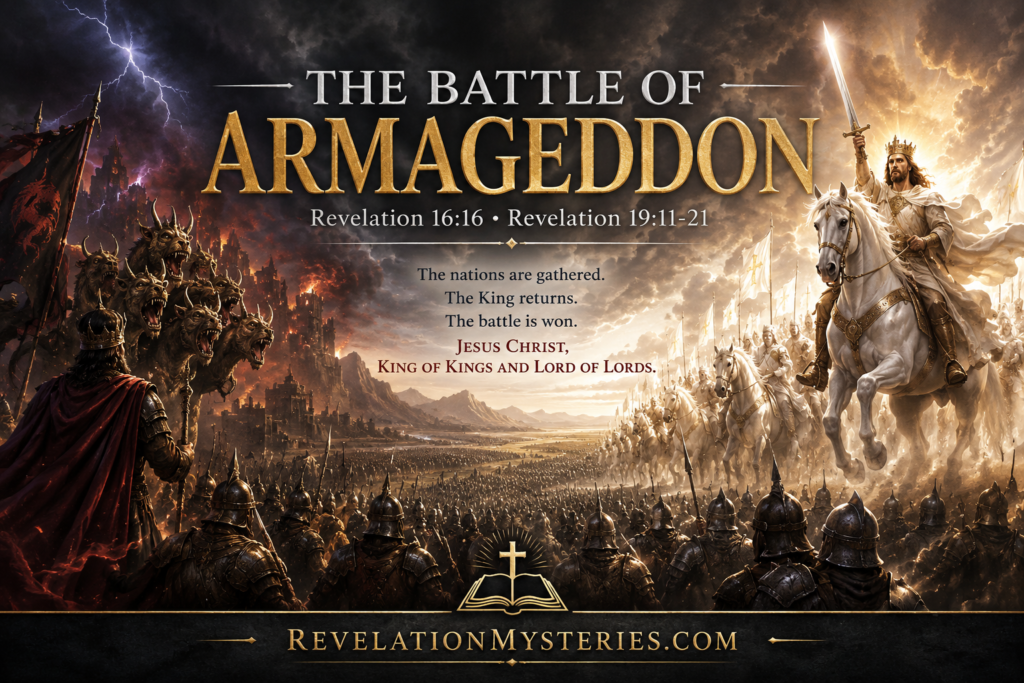
The Battle of Armageddon: What the Bible Says About the Final Battle
The Battle of Armageddon is one of the most dramatic and mysterious events described in Bible prophecy. Revelation 16 reveals that the kings of the earth will be gathered together at a place called Armageddon, setting the stage for the climactic confrontation between the forces of evil and Jesus Christ.
But what exactly is the Battle of Armageddon? Where will it take place? Who will fight in it? How does the Antichrist fit into the battle? And what happens when Jesus Christ returns?
The answers are found primarily in Revelation 16 and Revelation 19, along with important prophetic passages throughout the Old Testament and New Testament.
The Bible's message is ultimately one of victory. The armies of the world may gather against God, but they will not defeat Him. When Jesus Christ returns as King of Kings and Lord of Lords, the Beast and his armies will be defeated.
This page examines the Battle of Armageddon from a biblical perspective and explains how it fits into the larger timeline of end-times prophecy, the Tribulation, the Second Coming of Christ, and the establishment of Christ's kingdom.
What Is the Battle of Armageddon?
The Battle of Armageddon refers to the final gathering of the nations and their armies in opposition to God during the end times.
The word Armageddon appears in Revelation 16:16:
“And they assembled them at the place that in Hebrew is called Armageddon.” — Revelation 16:16, ESV
Revelation 16 describes demonic spirits going out to the kings of the earth and gathering them for “the great day of God the Almighty.”
The gathering occurs during the seventh and final series of judgments, known as the seven bowl judgments. The sixth bowl prepares the way for the gathering, while the seventh bowl brings a massive earthquake and other catastrophic judgments.
Revelation 19 then describes the armies of the earth gathered against Christ and His heavenly army. The Beast is captured, the false prophet is defeated, and the armies opposing Christ are destroyed.
For this reason, many Bible students understand Revelation 16 and Revelation 19 as describing different aspects of the same climactic end-times conflict.
In simple terms:
Armageddon is the climactic confrontation in which the forces of the Beast gather against God, only to be decisively defeated by Jesus Christ at His return.
Where Is Armageddon?
One of the most frequently asked questions about Bible prophecy is:
Where is Armageddon?
The name Armageddon is associated with Megiddo, an ancient location in the northern part of Israel.
A common understanding of the Hebrew expression is “Mountain of Megiddo.” Megiddo was historically associated with important battles, which helps explain why the name became connected with the final conflict described in Revelation.
However, Scripture does not provide a detailed military map showing that every army will be concentrated on one specific modern battlefield.
This is important when interpreting Revelation.
The Bible says the kings of the earth are gathered to “the place” called Armageddon, but the larger prophetic passages describe events involving nations, armies, Jerusalem, Christ's return, and God's judgment.
Therefore, it is wise to distinguish between what Scripture explicitly states and what is speculation.
Battle of Armageddon in Revelation 16
The clearest reference to Armageddon occurs in Revelation 16.
The chapter describes the seven bowls of God's wrath. As the sixth bowl is poured out, the Euphrates is dried up, preparing the way for the kings from the east.
John then sees three unclean spirits coming from the dragon, the Beast, and the false prophet.
These demonic spirits perform signs and go to the kings of the earth.
Their purpose is to gather the world's rulers for the great day of God Almighty.
Then comes the statement:
“And they assembled them at the place that in Hebrew is called Armageddon.” — Revelation 16:16, ESV
The significance is enormous.
Human rulers believe they are gathering for war, but ultimately they are being brought into a confrontation with God Himself.
The apparent power of the Beast and his coalition will not prevent God's purposes from being fulfilled.
The Sixth Bowl and the Gathering of the Nations
The Battle of Armageddon does not suddenly appear without warning.
Revelation 16 presents a sequence of events leading toward the final confrontation.
The sixth bowl includes the drying up of the Euphrates and the gathering of the kings of the earth.
The text describes demonic spirits going throughout the world and assembling the nations for battle.
This demonstrates an important theme in Revelation:
The final conflict is not merely a human political or military event. It has a profound spiritual dimension.
Behind the rebellion of the nations are the dragon, the Beast, and the false prophet.
The forces of evil are attempting to resist the authority of God.
Yet God remains sovereign throughout the entire sequence.
Who Fights in the Battle of Armageddon?
The Bible identifies several major groups involved in the final confrontation.
1. The Kings of the Earth
Revelation describes the kings of the earth being gathered for the great day of God Almighty.
These rulers represent the political and military forces assembled in opposition to God.
2. The Beast
The Beast is the central political ruler of the end-times system described in Revelation.
He exercises tremendous authority and receives worship from those who follow him.
At Armageddon, however, his apparent power comes to an end.
Revelation 19 says that the Beast is captured when Christ returns.
3. The False Prophet
The false prophet works alongside the Beast and deceives people through miraculous signs.
He is also captured when Christ returns and is thrown into the lake of fire.
4. The Armies of the Earth
Revelation 19:19 describes the Beast, the kings of the earth, and their armies gathered together to make war against the Rider on the white horse.
These armies ultimately cannot stand against Christ.
5. Jesus Christ
The central figure in the Battle of Armageddon is not the Antichrist.
It is Jesus Christ.
Revelation 19 presents Christ as the victorious King riding on a white horse.
He is called Faithful and True, and He judges and makes war in righteousness.
His title is unmistakable:
King of Kings and Lord of Lords.
Jesus Christ Returns at Armageddon
Revelation 19 gives one of the most powerful descriptions of the Second Coming of Jesus Christ in the Bible.
John sees heaven opened.
A rider appears on a white horse.
He is called:
- Faithful and True
- The Word of God
- King of Kings
- Lord of Lords
His eyes are described as being like flames of fire, and He wears many crowns.
He is followed by the armies of heaven.
This is the glorious return of Christ.
The One who was rejected, crucified, and raised from the dead returns in power and authority.
The Beast and the kings of the earth may gather their armies, but they are completely outmatched.
The final battle is not presented as a contest in which Christ might lose.
Christ wins.
Revelation 19 and the Final Battle of Armageddon
Revelation 19 provides the most detailed description of the actual confrontation.
John sees:
“the beast and the kings of the earth with their armies gathered to make war against him who was sitting on the horse and against his army.” — Revelation 19:19, ESV
Notice what happens next.
There is no prolonged description of a conventional military battle.
Instead, the Beast is captured.
The false prophet is captured.
Both are thrown alive into the lake of fire.
The remaining armies are defeated by the sword proceeding from Christ's mouth.
The scene emphasizes the overwhelming authority of Jesus Christ.
The final victory does not depend upon superior human weapons, military strategy, or political power.
Christ conquers because He is Lord.
Battle of Armageddon and the Antichrist
The Antichrist is one of the most important figures in end-times prophecy.
In Revelation, the Beast rises to tremendous authority and receives allegiance from the nations.
He is associated with the persecution of God's people, the mark of the Beast, false worship, and opposition to God.
The Antichrist's apparent reign reaches its climax during the final period of the Tribulation.
He gathers with the kings of the earth and their armies.
But his reign ends when Christ returns.
Revelation 19 specifically states that the Beast is captured and thrown into the lake of fire.
This connects the Battle of Armageddon directly with the ultimate defeat of the Antichrist.
Armageddon and the Second Coming of Christ
The Battle of Armageddon cannot be properly understood without understanding the Second Coming of Jesus Christ.
Revelation 19 places the return of Christ at the center of the final confrontation.
Jesus does not return secretly.
John sees heaven opened and Christ appearing in glory.
He comes as a conquering King.
The armies of heaven follow Him.
His authority is absolute.
The Second Coming therefore represents the dramatic turning point in the conflict between the kingdom of God and the rebellious kingdoms of the world.
The forces of evil have reached what appears to be their greatest strength.
Then Christ returns.
And everything changes.
Is Armageddon the Same as the Second Coming?
Armageddon and the Second Coming are closely connected, but they are not necessarily identical terms.
Armageddon describes the gathering of the nations for the final conflict.
The Second Coming describes the return of Jesus Christ in glory.
Revelation 16 focuses on the gathering.
Revelation 19 focuses on Christ's appearing and the defeat of the Beast and his armies.
Together, these passages present the climactic sequence:
The nations gather → Christ returns → the Beast is defeated → the armies of the Beast are destroyed → Christ's authority is established.
This is why Armageddon is one of the most important events to understand when studying the biblical end-times timeline.
The Seven Bowls and Armageddon
Armageddon occurs within the context of the seven bowl judgments described in Revelation 16.
The seven bowls represent the final judgments poured out upon the earth.
They include:
- Painful sores
- The sea becoming blood
- Rivers and springs becoming blood
- Scorching heat from the sun
- Darkness over the Beast's kingdom
- The drying of the Euphrates and gathering of the nations
- A massive earthquake and devastating hail
The sixth bowl is particularly important because it introduces the gathering at Armageddon.
The seventh bowl then announces:
“It is done!”
Revelation describes an enormous earthquake, the collapse of cities, the judgment of Babylon, the disappearance of islands and mountains, and enormous hailstones falling from heaven.
These events demonstrate that Armageddon occurs within the final outpouring of God's judgment.
What Happens at the Battle of Armageddon?
The Bible gives us several important details about the outcome.
1. The Nations Are Gathered
The kings of the earth and their armies are assembled for the great conflict.
2. Christ Returns
Jesus appears from heaven as the victorious Rider on the white horse.
3. Christ Confronts the Beast
The Beast and his armies stand in opposition to Christ.
4. The Beast Is Defeated
The Beast is captured.
5. The False Prophet Is Defeated
The false prophet is captured with him.
6. Both Are Cast Into the Lake of Fire
The Beast and false prophet are thrown alive into the lake of fire.
7. The Armies Are Destroyed
The remaining armies are defeated.
8. Christ Is Victorious
The final result is not uncertain.
Jesus Christ wins.
Armageddon and the Tribulation
The Battle of Armageddon is closely associated with the Tribulation and its conclusion.
Jesus spoke of a future period of unprecedented distress in Matthew 24.
Revelation then provides extensive prophetic details concerning the Beast, persecution, judgments, deception, and God's final intervention.
As the Tribulation reaches its climax, the forces of the Beast gather for the final confrontation.
Armageddon therefore belongs near the climax of the biblical end-times timeline.
A simplified sequence is:
Tribulation → Seven Bowl Judgments → Gathering at Armageddon → Second Coming of Christ → Defeat of the Beast → Satan Bound → Millennial Kingdom
The precise ordering of some prophetic events is interpreted differently by Christians, so each passage should be examined carefully rather than forcing every detail into a predetermined timeline.
What Does Armageddon Mean?
The word Armageddon is derived from the Hebrew expression associated with the place of Megiddo.
Megiddo was an important ancient location and was the scene of significant battles in biblical history.
Because of its historical associations, the name became an appropriate symbol for the climactic conflict described in Revelation.
The important point, however, is not merely the geographical location.
The theological significance is much greater.
Armageddon represents the final confrontation between rebellious human powers and the sovereign rule of God.
The world's kingdoms appear powerful.
The Beast appears powerful.
The armies appear powerful.
But none of them can defeat Jesus Christ.
Armageddon in Bible Prophecy
The Battle of Armageddon is connected with numerous biblical themes.
These include:
- The Day of the Lord
- The Tribulation
- The Antichrist
- The Beast
- The False Prophet
- The Second Coming of Christ
- The seven bowl judgments
- God's judgment
- The kingdom of Christ
- The defeat of Satan
- The ultimate victory of God
Other prophetic passages also contribute to the larger biblical picture of God's final judgment upon rebellious nations.
Among the passages worth studying are:
Revelation 14, Revelation 16, Revelation 17, Revelation 19, Zechariah 12, Zechariah 14, Joel 3, Isaiah 63, Psalm 2, and Daniel 7.
These passages should be studied together because no single chapter provides every detail of the end-times conflict.
Armageddon and the Winepress of God's Wrath
Revelation 14 contains another powerful image associated with God's final judgment.
John sees a harvest of the earth followed by an image of a great winepress.
The imagery represents the terrible judgment of God upon those who have rebelled against Him.
Revelation 19 uses similar winepress imagery when describing Christ's victory over the nations.
This creates an important connection between Revelation 14 and Revelation 19.
The message is that God's judgment is approaching its final climax.
The imagery is intentionally powerful because Revelation wants its readers to understand the seriousness of rebellion against God.
Armageddon and Jerusalem
Jerusalem also plays an important role in end-times prophecy.
The prophetic books of the Old Testament describe future conflict surrounding Jerusalem, while Revelation describes the final confrontation involving Christ and the nations.
Zechariah 14 is especially important when studying the relationship between Jerusalem, the nations, and the coming of the Lord.
This is one reason Armageddon should not be studied as an isolated verse.
A complete study of Armageddon requires examining the broader biblical prophecy concerning Israel, Jerusalem, the nations, the Messiah, and the kingdom of God.
Armageddon vs. the Battle of Gog and Magog
Another common question is whether the Battle of Armageddon is the same event as the Battle of Gog and Magog.
The answer requires careful attention to the biblical texts.
Revelation 20 describes another gathering of the nations under the name Gog and Magog after the thousand years.
Those nations surround the camp of God's people and the beloved city, but fire comes down from heaven and consumes them.
Because Revelation 20 explicitly places this conflict after the thousand years, many interpreters distinguish it from the Armageddon conflict associated with Revelation 16 and Revelation 19.
Therefore, it is best not to automatically equate every biblical reference to a final battle.
Armageddon in Revelation 16 and the Gog and Magog rebellion in Revelation 20 occur in different prophetic contexts.
Why Does God Allow the Nations to Gather?
One of the most fascinating aspects of Armageddon is that the nations appear to gather in rebellion against God, yet God remains completely sovereign.
Revelation 16 describes the gathering as part of the great day of God Almighty.
This reveals a major theme throughout Revelation:
God is never losing control.
The Beast may appear to rule.
The nations may appear unstoppable.
Evil may appear victorious.
But God is moving history toward the fulfillment of His purposes.
Armageddon is therefore not a story about God's defeat.
It is a story about God's final victory.
The Great Lesson of Armageddon
The Battle of Armageddon teaches something much more important than military predictions.
It reveals the ultimate conflict between human rebellion and divine authority.
Throughout Revelation, humanity repeatedly refuses to repent even while experiencing God's judgments.
The Beast offers an alternative kingdom.
The false prophet promotes false worship.
The nations follow the Beast.
But their rebellion ultimately fails.
When Christ returns, the illusion of human sovereignty collapses.
Jesus is revealed as the true King.
Jesus Is King of Kings
One of the most important statements in Revelation 19 appears on Christ's clothing:
King of Kings and Lord of Lords.
This title summarizes the meaning of Armageddon.
The world may have many rulers.
The Beast may claim authority.
Political powers may dominate nations.
But there is only one ultimate King.
Jesus Christ.
Armageddon demonstrates that no earthly kingdom can permanently resist the kingdom of God.
Does the Bible Say Armageddon Will Be a Nuclear War?
The Bible does not specifically describe Armageddon as a nuclear war.
Modern discussions sometimes attempt to interpret the imagery of Revelation through contemporary military technology.
However, Scripture itself does not identify nuclear weapons as the cause of the destruction.
The biblical account should therefore be kept separate from speculation about modern weapons.
Revelation gives us what we need to know:
The nations gather, Christ returns, the Beast is defeated, and God's judgment is accomplished.
The exact modern military technology involved is not revealed.
Will Christians Be at the Battle of Armageddon?
Revelation 19 says that the armies of heaven follow Christ on white horses and are clothed in fine linen, white and clean.
Christians interpret the identity of these heavenly armies in different ways.
Some understand them to include redeemed believers.
Others emphasize angelic armies.
The important point is that Christ is the central victorious figure.
The battle does not depend upon human strength.
Christ Himself defeats His enemies.
What Happens After Armageddon?
Armageddon is not the end of God's prophetic plan.
After the defeat of the Beast and his armies, Revelation continues into chapter 20.
Satan is bound for a thousand years.
John then describes the thousand-year reign of Christ, commonly called the Millennial Kingdom.
After the thousand years, Satan is released for a short time and deceives the nations one final time.
This leads to the later conflict involving Gog and Magog.
God then decisively defeats those forces, and Satan is thrown into the lake of fire.
Revelation then moves toward the final judgment and ultimately the new heaven and new earth.
Therefore, Armageddon is a major turning point—but it is not the final chapter of God's prophetic story.
Where Does Armageddon Fit in the End-Times Timeline?
A simplified biblical prophecy timeline can be presented as follows:
1. The Rise of the Antichrist
The Beast rises to power and exercises authority over the nations.
2. The Tribulation
The world experiences an unprecedented period of conflict, persecution, deception, and divine judgment.
3. The Seven Bowl Judgments
God's final judgments are poured out upon the earth.
4. The Gathering at Armageddon
The kings of the earth are gathered for the great day of God Almighty.
5. The Second Coming of Christ
Jesus returns from heaven in glory.
6. The Defeat of the Beast
The Beast and false prophet are captured and thrown into the lake of fire.
7. The Millennial Kingdom
Revelation 20 describes Christ's thousand-year reign.
8. The Final Rebellion
Satan is released and deceives the nations.
9. The Final Judgment
God brings final judgment.
10. The New Heaven and New Earth
God creates the new heaven and new earth, and the New Jerusalem becomes the dwelling place of God's people.
This sequence is a simplified overview, and Christians differ on some details concerning the prophetic timeline.
Frequently Asked Questions About the Battle of Armageddon
What is the Battle of Armageddon?
The Battle of Armageddon is the climactic end-times gathering of the nations against God, described specifically in Revelation 16:16 and connected with the defeat of the Beast's armies in Revelation 19.
Where is Armageddon located?
Armageddon is associated with Megiddo in Israel. The name is commonly understood as referring to the Mountain of Megiddo.
In Unraveling The Mysteries of the Book Of Revelation I reveal many details about the location of the Battle of Armageddon that are shown in the Bible.
Is Armageddon mentioned in the Bible?
Yes. The word Armageddon appears specifically in Revelation 16:16. Other passages, especially Revelation 19, describe the corresponding final confrontation between Christ and the Beast's armies.
Who wins the Battle of Armageddon?
Jesus Christ wins. Revelation 19 describes Christ defeating the Beast and the armies gathered against Him.
Does the Antichrist die at Armageddon?
Revelation identifies the Antichrist figure as the Beast and says that he is captured and thrown alive into the lake of fire.
Is Armageddon before or after the Tribulation?
In interpretations that place the Battle of Armageddon at the climax of the Tribulation, it occurs near the end of the Tribulation and immediately before or in connection with Christ's Second Coming.
Is Armageddon the end of the world?
Armageddon is not the final event described in Revelation. Revelation continues with the Millennium, Satan's final rebellion, final judgment, and ultimately the new heaven and new earth.
Is Armageddon the same as the Second Coming?
They are closely connected but describe different aspects of the final conflict. Revelation 16 describes the gathering at Armageddon, while Revelation 19 describes Christ's glorious return and victory over the Beast and his armies.
Is Armageddon the same as Gog and Magog?
Not necessarily. Revelation 20 places the Gog and Magog rebellion after the thousand-year reign, which is why many interpreters distinguish it from the Armageddon conflict in Revelation 16 and 19.
Bible Verses About Armageddon
When studying the Battle of Armageddon, these passages are especially important:
Revelation 16:13–16
The demonic spirits gather the kings of the earth for the great day of God Almighty, culminating in the reference to Armageddon.
Revelation 16:17–21
The seventh bowl brings the declaration “It is done,” a tremendous earthquake, the fall of cities, and enormous hailstones.
Revelation 19:11–16
Jesus Christ appears as the victorious Rider on the white horse.
Revelation 19:17–21
The Beast, the kings of the earth, and their armies are gathered against Christ, but the Beast and false prophet are defeated.
Zechariah 14
An important Old Testament prophecy concerning the coming of the Lord and events surrounding Jerusalem.
Joel 3
A significant prophetic passage concerning the gathering and judgment of the nations.
Isaiah 63
Contains powerful imagery of God's judgment and the winepress.
Psalm 2
Describes the nations raging against the Lord and His Anointed but ultimately being brought under God's authority.
The Good News Beyond Armageddon
The Battle of Armageddon is a sobering prophecy.
But Revelation is ultimately a book of hope for those who belong to Jesus Christ.
The final message is not that evil wins.
It is not that the Beast wins.
It is not that Satan wins.
Jesus Christ wins.
Revelation moves from judgment to the glorious restoration of God's creation.
The story ends with God dwelling with His people.
Death is defeated.
Suffering comes to an end.
The curse is removed.
And the people of God enter into the eternal kingdom prepared for them.
The Battle of Armageddon therefore points beyond judgment to the ultimate establishment of God's righteous kingdom.
Conclusion: The Battle of Armageddon Explained
The Battle of Armageddon is one of the most important events in biblical end-times prophecy.
Revelation 16 describes the gathering of the kings of the earth at Armageddon.
Revelation 19 reveals the dramatic return of Jesus Christ and the defeat of the Beast and his armies.
The message is clear:
The kingdoms of this world cannot defeat the King of Kings.
The Antichrist's power will end. The Beast will be defeated. The false prophet will be judged. The armies gathered against Christ will be destroyed.
And Jesus Christ will be revealed as the victorious King of Kings and Lord of Lords.
Armageddon is therefore more than a prophecy about a future battle.
It is a declaration that Jesus Christ will ultimately triumph over every power that opposes God.
If you want to understand the Battle of Armageddon in the context of the complete Book of Revelation, continue studying the Tribulation, Antichrist, Mark of the Beast, Seven Bowls, Second Coming, Millennium, and Revelation Timeline.
The final battle belongs to God—and the final victory belongs to Jesus Christ.
Continue Studying the Book of Revelation
The seven seals are only the beginning of some of the most remarkable prophetic visions in Scripture.
Continue your study of the Book of Revelation by exploring on revelationmysteries.com:
- Revelation Explained
- Revelation Timeline
- The Seven Trumpets in Revelation
- The Seven Bowls of God’s Wrath
- The Four Horsemen of the Apocalypse
- The 144,000 in Revelation 7
- The Great Multitude in Revelation 7
- The Antichrist in Revelation
- The Beast of Revelation 13
- The Mark of the Beast
- Babylon the Great
- Armageddon
- The Second Coming of Jesus
- The Millennium
- The Great White Throne Judgment
- The New Jerusalem
- The New Heaven and New Earth
The more carefully we study Revelation in its biblical context, the more clearly we see that its ultimate purpose is not to satisfy curiosity about the future.
It is to reveal Jesus Christ and call His people to remain faithful until He comes.
Why Buy Unraveling The Mysteries of the Book Of Revelation?
The Book of Revelation is one of the most fascinating, challenging, and often misunderstood books of the Bible.
Filled with visions, symbols, prophetic events, heavenly scenes, judgments, spiritual warfare, the Antichrist, the beast, Babylon, the return of Jesus Christ, the Millennium, the final judgment, the New Jerusalem, and the new heaven and new earth, Revelation can seem overwhelming when you first begin reading it.
Unraveling The Mysteries of The Book of Revelation by Kevin Bart was written to help readers understand this remarkable book of the Bible in a clear, organized, and accessible way.
Rather than treating Revelation as an impossible mystery, this book examines its major prophecies, symbols, events, and themes while seeking to understand them in light of Scripture.
Answering All Your Questions About Revelation
Since Unraveling The Mysteries of the Book Of Revelation by Kevin Bart is a clear verse-by-verse guide to understanding end times prophecy and Revelation, it answers all of the questions people have.
If you have ever asked questions such as:
- Can the Book of Revelation be explained?
- How should Revelation be interpreted?
- Does the Book Of Revelation have a timeline?
- Who are the 144,000 in Revelation?
- What are the seven seals?
- Who are the 4 horsemen of the Apocalypse?
- What are the seven trumpets?
- What are the seven bowls of God’s wrath?
- Who is the Antichrist?
- What is the mark of the beast?
- Who are the two witnesses?
- What is Babylon in Revelation?
- When will Jesus return?
- What is the Millennium?
- What happens after the final judgment?
- What is the New Jerusalem?
- What does Revelation say about the end times?
- Why should I buy and read Unraveling The Mysteries of the Book Of Revelation?
then Unraveling The Mysteries of the Book of Revelation was written for you.
 Kevin Bart has been a follower of Jesus for over 40 years. Kevin has taught Bible study classes, small groups, and discipleship classes for many years. He developed Pursuing Intimacy With God(opens in new tab) Bible studies website and book after many years of seeking God and studying His word. Kevin and his wife Nancy have 3 sons and 2 precious grandchildren.
Kevin is a former business owner, and current international missions ministry leader with more than four decades of combined business and ministry experience. After building and running a successful business for 23 years, with God’s guidance and blessings, he sold his company to dedicate himself to full-time global missions.
For over 20 years, Kevin and his wife Nancy have led a self funded international missions ministry. Utilizing learned business and financial management skills, as well as knowledge and experience in travel points and miles, to date they have had more than 5o mission trips to 36 countries in the Caribbean, Central America, South America, Europe, Africa, and Asia.
After many years of studying the Bible and the Book of Revelation, and writing many Bible studies and articles, Kevin finally finished Unraveling The Mysteries of the Book Of Revelation(opens in new tab). Hopefully it will be a blessing to many people.