New Jerusalem in Revelation 21–22: Meaning, Description & Biblical Explanation
New Jerusalem in the Book of Revelation
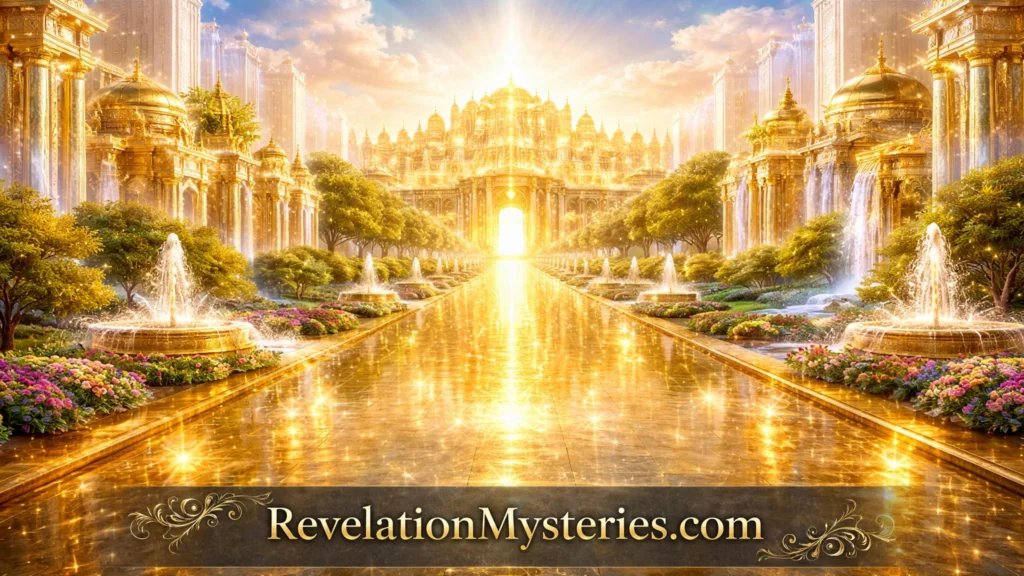
The New Jerusalem is one of the most remarkable visions in the entire Bible. Described in Revelation 21–22, the New Jerusalem is the holy city that John sees coming down out of heaven from God. It appears in the vision of the new heaven and new earth and represents the glorious culmination of God's redemptive plan.
The description of the New Jerusalem includes streets of gold, walls adorned with precious stones, twelve gates of pearl, twelve foundations, the glory of God, the throne of God and the Lamb, the river of the water of life, and the tree of life.
John writes:
“And I saw the holy city, new Jerusalem, coming down out of heaven from God.”
— Revelation 21:2
The New Jerusalem is not presented merely as a beautiful city. Revelation connects it with God dwelling with His people, the removal of death and suffering, and the restoration of what was lost in Eden.
This page examines what Revelation says about the New Jerusalem, its meaning, its dimensions and features, and its place in the biblical story of redemption.
What Is the New Jerusalem?
The New Jerusalem is the holy city John sees descending from heaven in Revelation 21. It is associated with the eternal dwelling of God with His redeemed people following the judgment and the creation of the new heaven and new earth.
Revelation describes it as:
A holy city
The New Jerusalem
Coming down out of heaven from God
Prepared like a bride
Filled with the glory of God
The dwelling place of God with His people
A city with twelve gates
A city with twelve foundations
A city whose light comes from God and the Lamb
A city containing the river of the water of life
A city containing the tree of life
The emphasis throughout Revelation 21–22 is that God's presence is at the center of this new creation.
“Behold, the dwelling place of God is with man.”
— Revelation 21:3
This is one of the central themes of the New Jerusalem: God will dwell with His people.
Where Is the New Jerusalem Mentioned in the Bible?
The primary description of the New Jerusalem is found in Revelation 21–22.
Revelation 21
Revelation 21 introduces the New Jerusalem and describes:
The new heaven and new earth
The holy city coming down from heaven
God dwelling with His people
The end of death, mourning, crying and pain
The city's enormous dimensions
Its walls and foundations
Its twelve gates
Its streets of gold
The absence of a temple
The glory of God illuminating the city
Revelation 22
Revelation 22 continues the vision by describing:
The river of the water of life
The throne of God and the Lamb
The tree of life
The healing of the nations
The absence of the curse
God's servants worshiping Him
Seeing God's face
God's name on the foreheads of His servants
Together, Revelation 21 and 22 provide the most detailed biblical description of the New Jerusalem.
The New Jerusalem Comes Down From Heaven
One of the most important details about the New Jerusalem is that John does not describe people ascending into heaven to discover the city.
He sees the city coming down from heaven.
“Then I saw a new heaven and a new earth...”
— Revelation 21:1
Then John says:
“And I saw the holy city, new Jerusalem, coming down out of heaven from God.”
— Revelation 21:2
This connects the New Jerusalem directly with the new heaven and new earth.
The picture presented in Revelation is therefore not simply of escaping the physical creation. Revelation culminates in God's purposes being brought to completion in a renewed creation where God dwells with His people.
The New Jerusalem Is Prepared As A Bride
John says that he saw:
“the holy city, new Jerusalem, coming down out of heaven from God, prepared as a bride adorned for her husband.”
The imagery of the bride is significant throughout Revelation.
The Bible frequently uses marriage imagery to describe the relationship between Christ and His people.
Earlier in Revelation, John describes:
“the marriage of the Lamb”
and the bride is associated with the redeemed people of God.
The New Jerusalem is therefore presented with rich bride and marriage imagery, emphasizing holiness, beauty, preparation and intimate fellowship with God.
God Will Dwell With His People
Perhaps the greatest feature of the New Jerusalem is not its gold, jewels or enormous dimensions.
It is God's presence.
Revelation 21:3 says:
“Behold, the dwelling place of God is with man.”
This fulfills one of the great themes running throughout Scripture.
From Genesis to Revelation, the Bible tells the story of God establishing fellowship with humanity, humanity's rebellion and separation from God, God's redemptive work, and ultimately the restoration of His dwelling with His people.
The New Jerusalem represents the culmination of that story.
No More Death, Mourning, Crying or Pain
One of the most comforting promises associated with the New Jerusalem is found in Revelation 21:4:
“He will wipe away every tear from their eyes, and death shall be no more.”
John continues by saying there will be no more:
Death
Mourning
Crying
Pain
The suffering associated with the present fallen world will have passed away.
This makes the New Jerusalem much more than a description of a beautiful city. It represents the final restoration of creation and the end of the consequences of sin and death.
What Does the New Jerusalem Look Like?
Revelation provides an extraordinary description of the city.
John describes:
A great and high wall
Twelve gates
Twelve angels at the gates
Twelve names representing the tribes of Israel
Twelve foundations
The names of the twelve apostles of the Lamb
Streets of pure gold
Transparent or glass-like gold
Precious stones
The glory of God
No need for sun or moon
The city is described using imagery of extraordinary beauty and value.
The Twelve Gates of the New Jerusalem
Revelation 21 describes twelve gates.
There are:
Three gates on the east
Three gates on the north
Three gates on the south
Three gates on the west
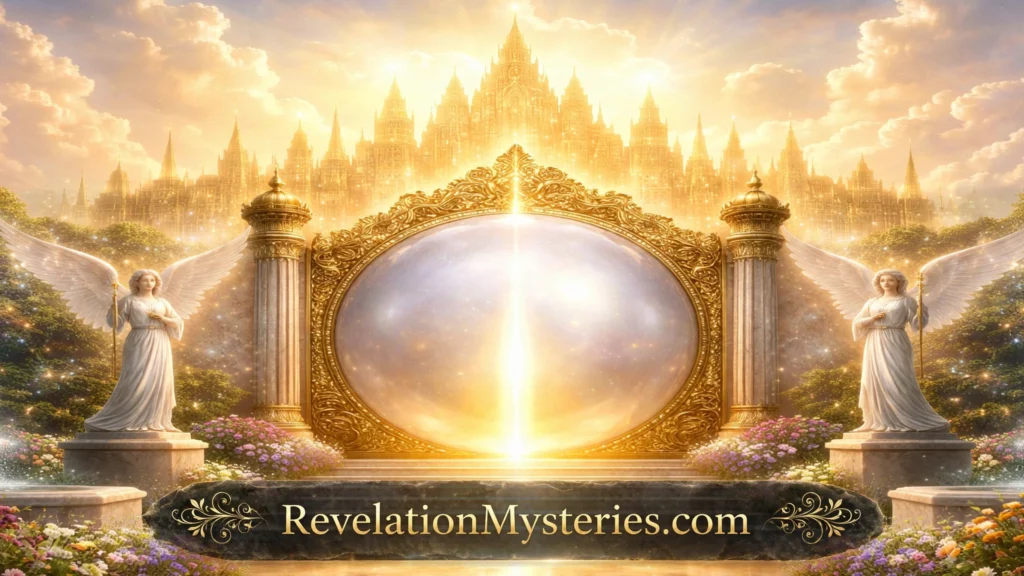
Each gate is described as being made from a single pearl.
This is the source of the familiar expression “pearly gates.”
However, Revelation's description is far more detailed than the popular expression suggests.
The gates also have the names of the twelve tribes of the sons of Israel written on them.
This connects the New Jerusalem with God's covenant purposes revealed throughout Scripture.
The Twelve Foundations of the New Jerusalem
The city also has twelve foundations.
Revelation 21:14 says:
“And the wall of the city had twelve foundations, and on them were the twelve names of the twelve apostles of the Lamb.”
This creates an important biblical connection.
The gates bear the names of the twelve tribes of Israel, while the foundations bear the names of the twelve apostles.
The imagery brings together major elements of God's redemptive work revealed in both the Old and New Testaments.
The Dimensions of the New Jerusalem
One of the most fascinating details in Revelation is the size of the city.
An angel measures the city with a golden measuring rod.
Revelation 21:16 says:
“The city lies foursquare, its length the same as its width.”
The city measures 12,000 stadia in length, width and height.
A stadion was an ancient unit of distance, and translations commonly render the measurement as approximately 1,400–1,500 miles, depending on the conversion used.
The important biblical point is that the city is described as an enormous cube-like structure.
Its:
Length
Width
Height
are equal.
This extraordinary description has led to considerable discussion about the symbolism and meaning of the city's dimensions.
Why Is the New Jerusalem a Cube?
The cubic shape of the New Jerusalem is particularly interesting when compared with the Old Testament.
The Most Holy Place, or Holy of Holies, in Solomon's temple was also described as a cube.
The Holy of Holies represented the special dwelling place of God's presence.
In Revelation 21, however, John says that he saw no temple in the city:
“for its temple is the Lord God the Almighty and the Lamb.”
The entire city is therefore associated with God's presence.
Whether one interprets the dimensions literally, symbolically, or as both, the imagery strongly emphasizes the holiness and presence of God.
The Walls of the New Jerusalem
Revelation says the city has a great and high wall.
The wall is measured at 144 cubits, according to the angel's measurement.
The text then describes the wall as being made of jasper.
The use of precious materials throughout the description emphasizes the extraordinary glory and beauty of the city.
The Foundations Are Decorated With Precious Stones
Revelation 21:19–20 describes twelve different precious stones associated with the foundations.
They include:
Jasper
Sapphire
Agate
Emerald
Onyx
Carnelian
Chrysolite
Beryl
Topaz
Chrysoprase
Jacinth
Amethyst
Translations can differ in how some of these ancient gemstones are identified, so individual stone names should be treated with some caution.
The larger message is unmistakable: the New Jerusalem is portrayed as extraordinarily beautiful and glorious.
The Streets of Gold
Revelation 21:21 says:
“And the street of the city was pure gold, transparent as glass.”
Gold is repeatedly associated with the extraordinary value and glory of the city.
The imagery is so different from ordinary human experience that it is difficult to imagine the scene using normal earthly categories.
Revelation uses familiar things—gold, jewels, pearls and precious stones—to communicate the incomparable glory of God's eternal city.
There Is No Temple in the New Jerusalem
One of the most surprising statements in Revelation 21 is:
“And I saw no temple in the city.”
Why?
John immediately gives the answer:
“for its temple is the Lord God the Almighty and the Lamb.”
The presence of God and the Lamb fills the city.
There is no need for a separate temple because God's presence is no longer represented indirectly.
God Himself dwells with His people.
There Is No Need for the Sun or Moon
The New Jerusalem also has no need for the sun or moon to provide its light.
Revelation 21:23 says:
“And the city has no need of sun or moon to shine on it, for the glory of God gives it light, and its lamp is the Lamb.”
This echoes the Old Testament promise in Isaiah 60, where God's glory is described as providing light for His people.
The imagery emphasizes that God Himself is the ultimate source of light and glory.
The Lamb Is the Lamp of the New Jerusalem
Jesus is repeatedly called the Lamb in Revelation.
In the New Jerusalem, the Lamb is described as its lamp.
This is a powerful continuation of one of Revelation's central themes:
Jesus Christ is at the center of God's eternal kingdom.
The city does not merely contain God's glory. Its light comes from God's glory and from the Lamb.
The Nations Will Walk by Its Light
Revelation 21:24 says:
“By its light will the nations walk.”
The nations are also described as bringing their glory into the city.
This language highlights the universal scope of God's final kingdom.
The vision is not restricted to one earthly nation or geographical location. Revelation presents people from every nation, tribe, people and language participating in God's redemptive purposes.
The Gates Will Never Be Shut
Another unusual feature of the New Jerusalem is that its gates are never shut.
Revelation 21:25 says:
“and its gates will never be shut by day—and there will be no night there.”
In the ancient world, city gates were often closed for protection.
In the New Jerusalem, there is no threat that requires the gates to be closed.
The city exists in perfect security.
The River of the Water of Life
Revelation 22 begins by describing one of the most beautiful images in Scripture:
“Then the angel showed me the river of the water of life, bright as crystal, flowing from the throne of God and of the Lamb.”
The river flows from the throne of God and the Lamb.
This image connects the New Jerusalem with the biblical theme of life flowing from God's presence.
It also recalls the river flowing from Eden and several Old Testament prophetic passages concerning life-giving waters.
The Tree of Life in the New Jerusalem
On either side of the river stands the tree of life.
The tree of life is one of the most significant connections between Genesis and Revelation.
In Genesis, humanity is driven from the Garden of Eden and access to the tree of life is prevented.
In Revelation, the tree of life appears again in the restored creation.
The biblical story that begins with the Garden of Eden ultimately concludes with God's redeemed people enjoying life in His presence.
The Tree of Life and the Healing of the Nations
Revelation 22 says that the leaves of the tree are:
“for the healing of the nations.”
This language has generated considerable discussion.
Revelation has already described the end of death, mourning, crying and pain. Therefore, the reference to healing should not necessarily be understood as indicating sickness continuing in the eternal state.
Instead, the imagery can be understood within Revelation's broader picture of restoration, life and wholeness.
There Will Be No More Curse
Revelation 22:3 contains another remarkable statement:
“No longer will there be anything accursed.”
This takes the reader back to Genesis.
After humanity's rebellion, the ground was cursed and death entered the human experience.
Revelation ends with the curse removed.
The New Jerusalem therefore represents the culmination of the biblical story of creation, fall, redemption and restoration.
We Will See God's Face
Revelation 22:4 says:
“They will see his face.”
This is an extraordinary statement.
Throughout Scripture, God's holiness and glory are treated with profound reverence. Yet in the final vision of Revelation, God's servants are described as seeing His face.
The verse continues:
“and his name will be on their foreheads.”
The people of God belong completely to Him.
Will There Be Night in the New Jerusalem?
No.
Revelation repeatedly emphasizes the absence of darkness.
Revelation 21:25 says there will be no night there, and Revelation 22:5 says:
“And night will be no more.”
There will be no need for lamps or natural sunlight because:
“the Lord God will be their light.”
The imagery again places God's presence at the center of the New Jerusalem.
Who Will Live in the New Jerusalem?
Revelation describes God's redeemed people as dwelling in His presence.
Revelation 21:3 says:
“They will be his people, and God himself will be with them as their God.”
Revelation also describes the nations and the kings of the earth in connection with the city.
At the same time, Revelation 21 gives a serious warning that those who remain in rebellion against God do not inherit the New Jerusalem.
The contrast between God's redeemed people and those who reject Him is part of Revelation's final judgment message.
Is the New Jerusalem Heaven?
The Bible does not simply use the New Jerusalem as another name for “heaven.”
Revelation specifically describes the city as coming down out of heaven from God and places it within the context of the new heaven and new earth.
Therefore, Revelation's final vision is broader than the traditional idea of human souls simply going to heaven.
The climax of the biblical story is God's dwelling with His people in a renewed creation.
Is the New Jerusalem a Literal City?
Christians have interpreted the New Jerusalem in different ways.
Some understand John's description as referring to a literal future city with extraordinary physical characteristics.
Others understand many of the city's details symbolically, pointing to spiritual realities such as God's presence, holiness, glory, security and the unity of God's redeemed people.
Others understand the vision as combining literal reality with highly symbolic imagery.
Revelation itself uses highly symbolic language throughout the book. Therefore, the details of the city's appearance have been the subject of considerable biblical interpretation.
Whatever interpretive approach is taken, the central themes are clear in the text:
God dwells with His people.
Death is no more.
The curse is removed.
God's glory illuminates the city.
The Lamb is at its center.
The river of life flows from God's throne.
The tree of life is present.
God's servants belong to Him.
God's eternal kingdom has come.
New Jerusalem and the Garden of Eden
One of the most fascinating ways to understand Revelation 21–22 is to compare it with Genesis 1–3.
Genesis Revelation
Creation New creation
Garden of Eden New Jerusalem
River flows from Eden River of life flows from God's throne
Tree of life Tree of life
Curse enters creation Curse removed
Death enters Death is no more
Humanity separated from God's presence God dwells with His people
Serpent deceives Serpent's defeat is complete
Access to tree of life restricted God's people have access to tree of life
The Bible begins with creation and a garden.
It ends with new creation and a glorious city containing the tree of life.
The New Jerusalem therefore represents the culmination of the biblical story.
New Jerusalem and the New Heaven and New Earth
The New Jerusalem should be understood within the larger vision of Revelation 21–22.
John first sees:
A new heaven and a new earth.
Then he sees:
The holy city, New Jerusalem, coming down from God.
This means the New Jerusalem is not an isolated subject. It is part of the final restoration described in Revelation.
For a more detailed study of the entire new creation, see our related guide:
New Heaven and New Earth in Revelation
New Jerusalem and the Bride of Christ
The imagery of the New Jerusalem and the bride is also significant.
Revelation 21:9 says:
“Come, I will show you the Bride, the wife of the Lamb.”
The angel then shows John the holy city, Jerusalem, coming down from heaven.
This passage connects the imagery of the Bride of the Lamb with the New Jerusalem.
The relationship between the city and the redeemed people of God has therefore been an important subject of biblical interpretation.
What Does the New Jerusalem Mean?
At its deepest level, the New Jerusalem communicates the fulfillment of God's promises.
It represents:
God's presence
God will dwell with His people.
Perfect restoration
The curse, death, mourning, crying and pain are removed.
Holiness
The city is repeatedly described in terms of holiness and purity.
Glory
The glory of God illuminates the city.
Eternal life
The river of life and tree of life dominate the closing vision.
Security
The gates remain open because there is no threat.
Fellowship
God's people see His face and serve Him.
The reign of Christ
The throne of God and the Lamb is at the center of the city.
Frequently Asked Questions About the New Jerusalem
What is the New Jerusalem in Revelation?
The New Jerusalem is the holy city John sees coming down from heaven in Revelation 21. It is associated with the new heaven and new earth and God's eternal dwelling with His redeemed people.
Where is the New Jerusalem mentioned?
The most detailed description is found in Revelation 21–22.
How big is the New Jerusalem?
Revelation 21:16 describes the city as measuring 12,000 stadia (1400 miles) in length, width and height.
How many gates does the New Jerusalem have?
The city has twelve gates, with three gates on each of its four sides.
What are the gates made of?
Each gate is described as being made from one pearl.
What are the foundations of the New Jerusalem?
The city has twelve foundations, associated with the names of the twelve apostles of the Lamb.
Will there be a temple in the New Jerusalem?
Revelation 21:22 says there is no temple because the Lord God Almighty and the Lamb are its temple.
Will there be a sun in the New Jerusalem?
Revelation says the city does not need the sun or moon because the glory of God gives it light and the Lamb is its lamp.
Will there be death in the New Jerusalem?
No. Revelation 21:4 says that death will be no more.
Is the New Jerusalem heaven?
Revelation describes the New Jerusalem as coming down out of heaven from God and places it within the new heaven and new earth.
What is the river of life?
Revelation 22 describes a river of the water of life flowing from the throne of God and the Lamb.
Is the tree of life in the New Jerusalem?
Yes. Revelation 22 describes the tree of life growing beside the river.
What happened to the curse?
Revelation 22:3 says that there will no longer be anything accursed.
The New Jerusalem: The Final Picture of God's Redemption
The New Jerusalem is the breathtaking conclusion to the Bible's story of redemption.
Continue Studying the Book of Revelation
The seven seals are only the beginning of some of the most remarkable prophetic visions in Scripture.
Continue your study of the Book of Revelation by exploring on revelationmysteries.com:
- Revelation Explained(opens in new tab)
- Revelation Timeline(opens in new tab)
- The Seven Trumpets in Revelation(opens in new tab)
- The Seven Bowls of God’s Wrath
- The Four Horsemen of the Apocalypse(opens in new tab)
- The 144,000 in Revelation 7(opens in new tab)
- The Great Multitude in Revelation 7
- The Antichrist in Revelation
- The Beast of Revelation 13
- The Mark of the Beast(opens in new tab)
- Babylon the Great
- Armageddon
- The Second Coming of Jesus(opens in new tab)
- The Millennium
- The Great White Throne Judgment
- The New Jerusalem(opens in new tab)
- The New Heaven and New Earth(opens in new tab)
The more carefully we study Revelation in its biblical context, the more clearly we see that its ultimate purpose is not to satisfy curiosity about the future.
It is to reveal Jesus Christ and call His people to remain faithful until He comes.
Why Buy Unraveling The Mysteries of the Book Of Revelation?
The Book of Revelation is one of the most fascinating, challenging, and often misunderstood books of the Bible.
Filled with visions, symbols, prophetic events, heavenly scenes, judgments, spiritual warfare, the Antichrist, the beast, Babylon, the return of Jesus Christ, the Millennium, the final judgment, the New Jerusalem, and the new heaven and new earth, Revelation can seem overwhelming when you first begin reading it.
Unraveling The Mysteries of The Book of Revelation by Kevin Bart was written to help readers understand this remarkable book of the Bible in a clear, organized, and accessible way.
Rather than treating Revelation as an impossible mystery, this book examines its major prophecies, symbols, events, and themes while seeking to understand them in light of Scripture.
Answering All Your Questions About Revelation
Since Unraveling The Mysteries of the Book Of Revelation(opens in new tab) by Kevin Bart is a clear verse-by-verse guide to understanding end times prophecy and Revelation, it answers all of the questions people have.
If you have ever asked questions such as:
- Can the Book of Revelation be explained?(opens in new tab)
- How should Revelation be interpreted?
- Does the Book Of Revelation have a timeline?(opens in new tab)
- Who are the 144,000 in Revelation?(opens in new tab)
- What are the seven seals?(opens in new tab)
- Who are the 4 horsemen of the Apocalypse?(opens in new tab)
- What are the seven trumpets?(opens in new tab)
- What are the seven bowls of God’s wrath?
- Who is the Antichrist?
- What is the mark of the beast?(opens in new tab)
- Who are the two witnesses?
- What is Babylon in Revelation?
- When will Jesus return?(opens in new tab)
- What is the Millennium?
- What happens after the final judgment?
- What is the New Heaven & Earth and New Jerusalem?(opens in new tab)
- What does Revelation say about the end times?
- Why should I buy and read Unraveling The Mysteries of the Book Of Revelation?(opens in new tab)
then Unraveling The Mysteries of the Book of Revelation was written for you.
 Kevin Bart(opens in new tab) has been a follower of Jesus for over 40 years. Kevin has taught Bible study classes, small groups, and discipleship classes for many years. He developed Pursuing Intimacy With God(opens in new tab)(opens in new tab) Bible studies website and book after many years of seeking God and studying His word. Kevin and his wife Nancy have 3 sons and 2 precious grandchildren.
Kevin is a former business owner, and current international missions ministry leader with more than four decades of combined business and ministry experience. After building and running a successful business for 23 years, with God’s guidance and blessings, he sold his company to dedicate himself to full-time global missions.
For over 20 years, Kevin and his wife Nancy have led a self funded international missions ministry. Utilizing learned business and financial management skills, as well as knowledge and experience in travel points and miles, to date they have had more than 5o mission trips to 36 countries in the Caribbean, Central America, South America, Europe, Africa, and Asia.
After many years of studying the Bible and the Book of Revelation, and writing many Bible studies and articles, Kevin finally finished Unraveling The Mysteries of the Book Of Revelation(opens in new tab)(opens in new tab). Hopefully it will be a blessing to many people.
Buy Your eBook(opens in new tab)
Buy Your Paperback(opens in new tab)
About the Author Kevin Bart(opens in new tab)
Articles About The Book of Revelation(opens in new tab)