Second Coming of Jesus Christ: What The Bible Says About Christ's Return
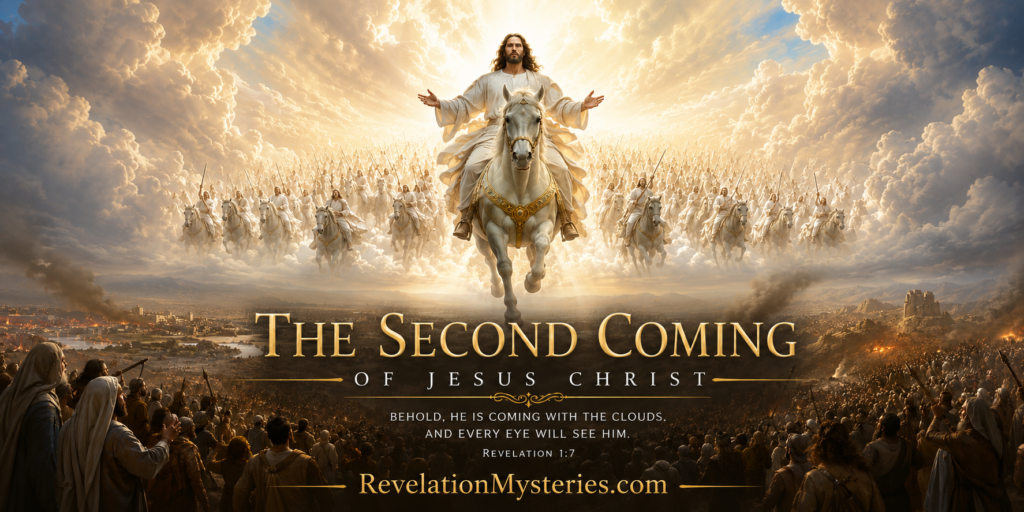
The Second Coming of Jesus Christ
The Second Coming of Jesus Christ is one of the most important promises in the Bible and one of the central events in end-times prophecy. Scripture teaches that Jesus Christ will return to earth in power and glory to judge evil, defeat His enemies, establish His kingdom, and ultimately bring God's prophetic plan to its appointed conclusion.
Unlike Jesus' first coming, when He came in humility as a servant and gave His life for the sins of the world, His Second Coming is described as a visible, glorious, triumphant return. Revelation presents Jesus as the victorious King of kings and Lord of lords, riding from heaven as He comes to judge and make war in righteousness.
The Second Coming is not merely a symbolic idea. The New Testament repeatedly points believers toward the future return of Christ. Jesus Himself taught His disciples about His coming, and the angels declared after His ascension that the same Jesus who was taken into heaven would come again. The book of Revelation brings these prophecies to a dramatic climax in Revelation 19.
For anyone seeking to understand end times prophecy, the return of Jesus, the Tribulation, Armageddon, the Antichrist, the Millennium, and the final victory of Christ, understanding the Second Coming is essential.
What Is the Second Coming of Jesus Christ?
The Second Coming of Jesus Christ refers to the future return of Jesus to earth in glory and power.
The Bible describes this event as a public manifestation of Christ's authority. Revelation 19 portrays heaven opening and Jesus appearing as a rider on a white horse. He is called Faithful and True, and He comes in righteousness to judge and make war. He is also identified as the Word of God and King of kings and Lord of lords.
This is dramatically different from Christ's first coming.
At His first coming:
- Jesus was born in Bethlehem.
- He came as a servant.
- He preached the kingdom of God.
- He healed the sick and performed miracles.
- He was rejected by many.
- He was crucified.
- He died for the sins of humanity.
- He rose from the dead.
- He ascended into heaven.
At His Second Coming:
- Jesus returns from heaven.
- He comes in glory.
- He comes with the armies of heaven.
- He judges the nations.
- He defeats the enemies gathered against Him.
- He is revealed as King of kings and Lord of lords.
- He establishes His righteous rule.
Revelation 19 presents Christ's return as the climactic victory over the forces of evil.
The Promise That Jesus Will Return
The promise of Christ's return goes back to the earliest days of Christianity.
After Jesus had risen from the dead, He ascended into heaven in the presence of His disciples. As the disciples watched Him go, angels told them that Jesus would return.
Acts 1:11 points believers toward the future return of Christ, declaring that the same Jesus who was taken into heaven would come again.
This promise is important because the Second Coming is not a new concept introduced only in Revelation. It is part of the broader biblical expectation concerning the Messiah.
Jesus repeatedly taught His followers to anticipate His return.
The New Testament therefore presents Christ's return as a certainty rather than a possibility.
Jesus' Teaching About His Second Coming
One of the most important passages concerning the return of Christ is Matthew 24.
Jesus' disciples asked Him about the sign of His coming and the end of the age. Jesus then described a series of events associated with the end times, including deception, wars, tribulation, persecution, false prophets, and dramatic signs preceding His appearing.
Jesus warned His followers not to be deceived.
This warning is especially important when studying end-times prophecy because Jesus emphasized that deception would be one of the defining characteristics of the period leading up to His return.
Matthew 24 also describes the coming of the Son of Man as a visible and glorious event.
The Second Coming therefore should not be understood as something hidden from the world.
Christ's return will reveal His identity and authority.
What Will the Second Coming of Jesus Look Like?
The most detailed picture of Christ's return appears in Revelation 19:11–21.
John writes about seeing heaven opened and a white horse. The rider is called Faithful and True, and He judges and makes war in righteousness.
His eyes are described as flames of fire, and He wears many crowns.
He is clothed in a robe associated with blood, and His name is The Word of God.
The armies of heaven follow Him on white horses.
On His robe and thigh is written:
KING OF KINGS AND LORD OF LORDS.
This description reveals something fundamental about the Second Coming:
Jesus returns as the victorious King.
His Second Coming is not another incarnation. It is the glorious manifestation of the risen and exalted Christ.
Jesus Returns as King of Kings
At the Second Coming, Jesus is presented as the supreme ruler over every earthly authority.
Revelation calls Him King of kings and Lord of lords.
This title emphasizes His absolute authority.
Earthly kingdoms rise and fall. Political powers come and go. Human rulers have limited authority and limited lifespans.
Jesus, however, returns as the ultimate King.
The Second Coming demonstrates that history is moving toward the reign of Christ rather than toward the permanent triumph of human government or evil.
The Second Coming and the Tribulation
The Second Coming is closely connected with the events of the Tribulation in many interpretations of biblical prophecy.
Revelation 19 follows the visions concerning Babylon, the beast, and the final conflict of the nations. Revelation then presents Christ's appearance from heaven and His victory over the forces opposing Him.
This creates an important prophetic sequence:
Tribulation → Gathering of the Nations → Christ's Return → Defeat of Christ's Enemies → Reign of Christ
The exact chronology of certain end-times events is interpreted differently by Christians, particularly concerning the relationship between the Rapture, Tribulation, and Second Coming.
However, Revelation 19 clearly places Christ's victorious return at the climax of the conflict between the kingdom of God and the forces of evil.
The Second Coming and the Battle of Armageddon
The Battle of Armageddon is one of the most well-known events associated with end-times prophecy.
Revelation describes the beast, the kings of the earth, and their armies gathered to make war against the returning Christ and His army.
Humanity's rebellion ultimately reaches its climax in opposition to Jesus Christ.
But the outcome is never in doubt.
Christ is victorious.
Revelation 19 presents the beast and the false prophet being defeated, while the armies gathered against Christ are overcome.
The message is powerful:
The forces of evil may appear powerful, but they cannot defeat Jesus Christ.
Jesus' Victory Over the Beast
Revelation 13 introduces the beast as a major figure in the final conflict.
The beast exercises tremendous authority and leads humanity in rebellion against God.
But his apparent power is temporary.
When Christ returns, the beast's authority comes to an end.
Revelation 19 presents the beast and the false prophet being captured and judged.
This demonstrates an important principle of biblical prophecy:
Evil has an expiration date.
The Antichrist's kingdom will not last forever.
Human rebellion will not last forever.
The kingdoms of this world will ultimately encounter the returning King.
The Second Coming vs. the Rapture
One of the most frequently asked questions about end-times prophecy is:
Are the Rapture and Second Coming the same event?
Christians have different interpretations concerning the relationship between these events.
The Rapture is commonly understood from passages such as 1 Thessalonians 4:13–18 and 1 Corinthians 15:51–52, which describe believers being caught up to meet Christ.
The Second Coming, particularly as described in Revelation 19, presents Christ coming in glory and judgment to earth.
Because different Christian traditions interpret the prophetic passages differently, it is important to distinguish what Scripture explicitly states from conclusions drawn from combining multiple passages.
Many evangelical interpretations distinguish the Rapture from the Second Coming, while disagreeing about the timing of the Rapture in relation to the Tribulation.
For a detailed study, see our Second Coming vs. Rapture resources and related end-times prophecy studies on RevelationMysteries.com.
Signs of the Second Coming of Jesus
Jesus gave several warnings concerning the period preceding His return.
Among the signs and characteristics He described are:
1. Deception
Jesus repeatedly warned about false messiahs and false prophets.
2. Wars and Rumors of Wars
Matthew 24 describes wars and rumors of wars while emphasizing that these events must be understood within the larger prophetic picture.
3. Persecution
Jesus warned that His followers would experience opposition because of His name.
4. False Prophets
Religious deception will increase as the end approaches.
5. Tribulation
Jesus spoke of a period of unprecedented distress.
6. Cosmic Signs
Jesus described dramatic signs associated with the heavens before His appearing.
7. The Coming of the Son of Man
Jesus ultimately described His coming in glory.
These passages should encourage believers to remain spiritually alert rather than attempting to predict a specific date.
Can We Know When Jesus Is Coming Back?
One of the most common questions about the Second Coming is:
When is Jesus coming back?
Jesus taught His followers to remain watchful because the exact timing of His return is not something human beings are given to calculate with certainty.
This is one reason date-setting has repeatedly proven unreliable.
The biblical emphasis is not on calculating a date but on being spiritually prepared.
The appropriate response to Christ's promised return is:
Watch. Be ready. Remain faithful.
No One Should Set a Date for Christ's Return
End-times prophecy has generated countless predictions about the exact date of Jesus' return.
But Scripture does not give Christians permission to set a date.
Instead, Jesus repeatedly emphasized watchfulness.
This has an important practical application.
We do not need to know the exact day Christ returns in order to live faithfully.
The certainty of His return should motivate Christians to:
- Follow Jesus faithfully.
- Remain spiritually alert.
- Resist deception.
- Share the gospel.
- Live holy lives.
- Encourage other believers.
- Look forward to Christ's kingdom.
The biblical message is not "figure out the date."
It is "be ready."
The Second Coming in Revelation 19
Revelation 19 is the central Second Coming passage in the book of Revelation.
The chapter moves from heavenly celebration to the dramatic appearance of Christ.
Revelation 19:1–6 — Praise in Heaven
Heaven rejoices over God's righteous judgment.
Revelation 19:7–10 — The Marriage Supper of the Lamb
The imagery shifts toward celebration and the marriage of the Lamb.
Revelation 19:11–16 — Christ Appears
Heaven opens and Jesus appears as the victorious rider on a white horse.
Revelation 19:17–18 — The Great Judgment
An angel announces a great gathering involving the enemies of God.
Revelation 19:19–21 — Christ Defeats His Enemies
The beast and the kings of the earth gather against Christ, but they are defeated.
Revelation 19 therefore serves as a major prophetic climax.
The chapter presents Christ's return as the decisive victory of Jesus over the powers of evil.
Why Is Jesus Riding a White Horse?
The white horse in Revelation 19 is part of the symbolic imagery John uses to communicate Christ's victory and authority.
The rider is not identified merely by the horse.
He is identified by His names and actions.
He is:
- Faithful and True
- The Word of God
- King of kings
- Lord of lords
The image communicates triumph, authority, righteousness, and judgment.
The returning Christ is not a defeated Messiah.
He is the victorious King.
The Names of Jesus at His Second Coming
The names given to Christ in Revelation 19 reveal much about His identity.
Faithful and True
Jesus is completely trustworthy and righteous.
The Word of God
This title connects the returning Christ with the biblical revelation of Jesus as the eternal Word.
King of Kings
No earthly king possesses authority greater than Christ.
Lord of Lords
Every human authority ultimately answers to Him.
These names are more than descriptions.
They reveal who Jesus is.
Jesus Will Judge in Righteousness
Revelation 19 says that Christ judges and makes war in righteousness.
This is important because human judgment is often imperfect.
Human governments can be corrupt.
Human courts can make mistakes.
Human beings can be deceived.
Jesus' judgment, however, is presented as righteous.
The Second Coming therefore involves not merely Christ's arrival but divine judgment.
God's justice will ultimately prevail.
The Armies of Heaven Follow Jesus
Revelation 19 describes armies in heaven following Christ on white horses.
They are dressed in fine linen, white and clean.
The imagery emphasizes that Christ does not return alone.
He comes in heavenly glory.
The return of Jesus is therefore portrayed as a magnificent cosmic event rather than a private or hidden occurrence.
What Happens After the Second Coming?
Revelation 19 leads directly into Revelation 20, where John describes a thousand-year reign and subsequent events concerning Satan, final judgment, and the ultimate defeat of evil.
Christ's victory at His Second Coming therefore begins another major phase of biblical prophecy.
Revelation 20 describes Satan being imprisoned, followed by the thousand-year reign and later final judgment.
Christians interpret the Millennium in different ways, including premillennial, amillennial, and postmillennial perspectives.
For a literal premillennial reading of Revelation, the Second Coming occurs before Christ's thousand-year reign on earth.
The Second Coming Leads Toward the Kingdom of Christ
The ultimate goal of biblical prophecy is not merely destruction.
It is the establishment of God's righteous rule and the restoration of creation.
The Bible's prophetic story moves toward God's final victory.
Revelation ultimately looks beyond judgment to a new heaven and new earth, where God dwells with His people and death, mourning, crying, and pain are no more.
This means the Second Coming should be understood within the larger biblical story:
Creation → Fall → Redemption → Christ's Return → Judgment → Kingdom → New Creation
Jesus Is Coming Again: What Does It Mean for Christians?
The Second Coming is both a warning and a promise.
For those who reject Christ, the return of Jesus represents coming judgment.
For believers, the return of Christ is a source of hope.
Jesus promised to return.
His kingdom will ultimately triumph.
Death will not have the final word.
Evil will not have the final word.
The Antichrist will not have the final word.
Satan will not have the final word.
Jesus Christ has the final word.
Bible Verses About the Second Coming of Jesus
Several passages are especially important when studying Christ's return.
Matthew 24
Jesus teaches about His coming and the signs associated with the end of the age.
Acts 1:9–11
The angels point the disciples toward Christ's future return.
1 Thessalonians 4:13–18
Paul teaches about the coming of the Lord and the gathering of believers.
1 Corinthians 15:51–52
Paul describes the transformation of believers at Christ's coming.
2 Peter 3
Peter discusses the Day of the Lord and the ultimate renewal of creation.
Revelation 1:7
Revelation begins by pointing readers toward Christ's coming.
Revelation 19:11–21
John gives one of Scripture's most dramatic visions of Christ's return and victory over His enemies.
Revelation 22:20
Revelation ends with the promise:
"Surely I am coming soon."
And the response is:
"Amen. Come, Lord Jesus!"
What Should We Do While Waiting for Jesus?
The promise of Christ's return should change the way we live today.
Jesus did not command His followers to become obsessed with predicting dates.
He commanded them to remain faithful.
While waiting for Christ:
Stay spiritually awake
Do not allow the distractions of this world to make you forget eternity.
Know God's Word
Scripture helps protect believers from deception.
Share the Gospel
The message of salvation through Jesus Christ remains central.
Live faithfully
Our hope in Christ's return should produce faithful Christian living.
Encourage other believers
The promise of Christ's return gives Christians a reason to encourage one another.
Look forward to Christ's kingdom
The future belongs to Jesus.
The Greatest Hope of the Second Coming
The Second Coming of Jesus Christ is ultimately about Jesus.
It is easy to become fascinated with prophetic signs, world events, the Antichrist, the Tribulation, Armageddon, or attempts to construct an end-times timeline.
But Revelation is called the revelation of Jesus Christ.
The central figure of prophecy is not the Antichrist.
It is not the beast.
It is not Babylon.
It is not Armageddon.
It is Jesus Christ.
Revelation 19 brings the reader's attention back to Him.
He is Faithful and True.
He is the Word of God.
He is King of kings.
He is Lord of lords.
And He is coming again.
Frequently Asked Questions About the Second Coming of Jesus
What is the Second Coming of Jesus Christ?
The Second Coming is the future return of Jesus Christ to earth in glory and power. Revelation 19 portrays Christ returning from heaven as the victorious King who judges His enemies and defeats the forces gathered against Him.
When is Jesus coming back?
The Bible does not give believers a date they can reliably calculate. Jesus emphasized watchfulness and readiness rather than date-setting.
Is the Second Coming the same as the Rapture?
Christians disagree about how these events relate to one another. Many evangelical interpretations distinguish the Rapture from the visible, glorious return of Christ described in Revelation 19.
What happens when Jesus comes back?
Revelation 19 describes Christ returning from heaven, judging His enemies, defeating the beast and the armies gathered against Him, and establishing His victorious rule.
Where does Jesus return?
Several biblical passages connect the Lord's future appearing with Jerusalem and the Mount of Olives, while Revelation 19 emphasizes Christ's descent from heaven and His victory over the nations.
What is Revelation 19 about?
Revelation 19 describes heavenly praise, the marriage supper of the Lamb, the appearance of Christ as the rider on a white horse, and His victory over the beast and the armies of the earth.
Will Jesus really return?
The New Testament repeatedly teaches the future return of Jesus. The Second Coming is presented as a central Christian hope and a major event in biblical prophecy.
The Second Coming of Jesus Christ: The Final Answer
The Bible's message about the Second Coming is clear:
Jesus Christ is coming again.
He came the first time in humility.
He will come again in glory.
He came the first time to provide salvation.
He will come again to judge and reign.
He came the first time as the suffering servant.
He will come again as the victorious King.
Revelation 19 gives us a breathtaking picture of the returning Christ. Heaven opens. The King rides forth. His enemies gather. The battle reaches its climax.
And Jesus wins.
The Second Coming is therefore not a story about whether Christ will triumph.
It is a revelation of how Christ will triumph.
The final chapters of Revelation then point beyond judgment toward God's ultimate restoration of creation, culminating in the new heaven and new earth where God dwells with His people.
The book of Revelation ends with the promise of Jesus:
He is coming again.
And the appropriate response is the same response given at the end of Revelation:
Come, Lord Jesus.
Continue Studying the Book of Revelation
The seven seals are only the beginning of some of the most remarkable prophetic visions in Scripture.
Continue your study of the Book of Revelation by exploring on revelationmysteries.com:
- Revelation Explained
- Revelation Timeline
- The Seven Trumpets in Revelation
- The Seven Bowls of God’s Wrath
- The Four Horsemen of the Apocalypse
- The 144,000 in Revelation 7
- The Great Multitude in Revelation 7
- The Antichrist in Revelation
- The Beast of Revelation 13
- The Mark of the Beast
- Babylon the Great
- Armageddon
- The Second Coming of Jesus
- The Millennium
- The Great White Throne Judgment
- The New Jerusalem
- The New Heaven and New Earth
The more carefully we study Revelation in its biblical context, the more clearly we see that its ultimate purpose is not to satisfy curiosity about the future.
It is to reveal Jesus Christ and call His people to remain faithful until He comes.
Why Buy Unraveling The Mysteries of the Book Of Revelation?
The Book of Revelation is one of the most fascinating, challenging, and often misunderstood books of the Bible.
Filled with visions, symbols, prophetic events, heavenly scenes, judgments, spiritual warfare, the Antichrist, the beast, Babylon, the return of Jesus Christ, the Millennium, the final judgment, the New Jerusalem, and the new heaven and new earth, Revelation can seem overwhelming when you first begin reading it.
Unraveling The Mysteries of The Book of Revelation by Kevin Bart was written to help readers understand this remarkable book of the Bible in a clear, organized, and accessible way.
Rather than treating Revelation as an impossible mystery, this book examines its major prophecies, symbols, events, and themes while seeking to understand them in light of Scripture.
Answering All Your Questions About Revelation
Since Unraveling The Mysteries of the Book Of Revelation by Kevin Bart is a clear verse-by-verse guide to understanding end times prophecy and Revelation, it answers all of the questions people have.
If you have ever asked questions such as:
- Can the Book of Revelation be explained?
- How should Revelation be interpreted?
- Does the Book Of Revelation have a timeline?
- Who are the 144,000 in Revelation?
- What are the seven seals?
- Who are the 4 horsemen of the Apocalypse?
- What are the seven trumpets?
- What are the seven bowls of God’s wrath?
- Who is the Antichrist?
- What is the mark of the beast?
- Who are the two witnesses?
- What is Babylon in Revelation?
- When will Jesus return?
- What is the Millennium?
- What happens after the final judgment?
- What is the New Heaven & Earth and New Jerusalem?
- What does Revelation say about the end times?
- Why should I buy and read Unraveling The Mysteries of the Book Of Revelation?
then Unraveling The Mysteries of the Book of Revelation was written for you.
 Kevin Bart has been a follower of Jesus for over 40 years. Kevin has taught Bible study classes, small groups, and discipleship classes for many years. He developed Pursuing Intimacy With God(opens in new tab) Bible studies website and book after many years of seeking God and studying His word. Kevin and his wife Nancy have 3 sons and 2 precious grandchildren.
Kevin is a former business owner, and current international missions ministry leader with more than four decades of combined business and ministry experience. After building and running a successful business for 23 years, with God’s guidance and blessings, he sold his company to dedicate himself to full-time global missions.
For over 20 years, Kevin and his wife Nancy have led a self funded international missions ministry. Utilizing learned business and financial management skills, as well as knowledge and experience in travel points and miles, to date they have had more than 5o mission trips to 36 countries in the Caribbean, Central America, South America, Europe, Africa, and Asia.
After many years of studying the Bible and the Book of Revelation, and writing many Bible studies and articles, Kevin finally finished Unraveling The Mysteries of the Book Of Revelation(opens in new tab). Hopefully it will be a blessing to many people.