The Tribulation: What Is It, When Will It Happen, and What Does the Bible Say?
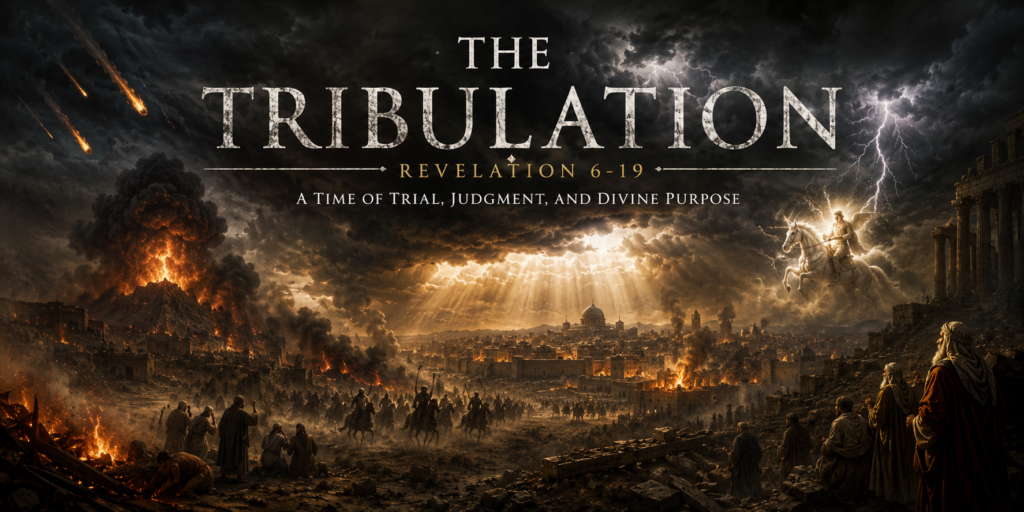
The Tribulation is one of the most discussed and debated subjects in Bible prophecy. Scripture describes a future period of unprecedented trouble, persecution, judgment, deception, and worldwide upheaval that will culminate in the return of Jesus Christ.
But what exactly is the Tribulation? Is it the same thing as the Great Tribulation? How does it relate to the Rapture, the Antichrist, the seven seals, seven trumpets, and seven bowls of God's wrath in the Book of Revelation?
This comprehensive guide examines what the Bible says about the Tribulation and explains the major prophetic events associated with this extraordinary period.
Whether you are beginning a study of Bible prophecy or want to understand the prophetic timeline of Revelation more clearly, this page will help you understand the Tribulation from a biblical perspective.
What Is the Tribulation?
The Tribulation refers to a future period of severe distress and worldwide upheaval associated with the fulfillment of biblical prophecy.
Jesus described this coming period in His Olivet Discourse:
“For then there will be great tribulation, such as has not been from the beginning of the world until now, no, and never will be.”
— Matthew 24:21 ESV
The Tribulation will involve much more than wars and natural disasters. According to biblical prophecy, it will include tremendous spiritual deception, persecution of believers, worldwide conflict, divine judgments, and the rise of powerful forces opposed to God.
The Book of Revelation provides some of the most detailed descriptions of these events.
Revelation describes judgments associated with the seven seals, seven trumpets, and seven bowls, along with the rise of the Antichrist, the persecution of God's people, the mark of the beast, and the final confrontation between the forces of evil and Jesus Christ.
What Is the Great Tribulation?
The term Great Tribulation comes directly from Jesus' teaching in Matthew 24:21.
While Christians sometimes use “Tribulation” and “Great Tribulation” interchangeably, some Bible prophecy teachers distinguish between the broader period of Tribulation and the particularly intense period Jesus called the Great Tribulation.
Jesus said:
“For then there will be great tribulation…”
— Matthew 24:21 ESV
He continued:
“And if those days had not been cut short, no human being would be saved. But for the sake of the elect those days will be cut short.”
— Matthew 24:22 ESV
The description emphasizes the unprecedented nature of this future time.
The Great Tribulation should therefore be understood as a period of extraordinary suffering and persecution connected with the final events preceding Christ's return.
How Long Is the Tribulation?
One of the most common questions about Bible prophecy is:
How long will the Tribulation last?
Many Christians understand Daniel's prophecy of the seventy weeks in Daniel 9:24–27 as providing the framework for a future seven-year prophetic period.
Daniel 9:27 describes a final “week” in which a covenant is confirmed for one week, followed by a significant event in the middle of that period.
Because a biblical prophetic “week” is commonly interpreted as seven years in this passage, many end-times teachers understand Daniel's final week as a seven-year Tribulation period.
This interpretation is particularly associated with a futurist understanding of Bible prophecy.
The seven-year framework is often divided into two periods of three and one-half years:
3½ years + 3½ years = 7 years
The second half is frequently associated with the most severe period of persecution and judgment.
What Does Daniel Say About the Tribulation?
The Book of Daniel is essential for understanding end-times prophecy.
Daniel contains several prophecies concerning kingdoms, rulers, persecution, and the final period of history.
Daniel 9:24–27 describes the seventy weeks prophecy, including a final period associated with the fulfillment of God's prophetic purposes.
Daniel also describes a future ruler who will oppose God and commit an act of profound sacrilege.
Daniel 12:1 provides another important description:
“And there shall be a time of trouble, such as never has been since there was a nation till that time.”
This passage closely parallels Jesus' description of the Great Tribulation in Matthew 24.
Daniel therefore provides important prophetic background for understanding the events described later by Jesus and John.
What Did Jesus Say About the Tribulation?
Jesus gave one of the clearest teachings about the Tribulation in Matthew 24.
He warned His disciples about:
- False messiahs
- False prophets
- Wars
- Rumors of wars
- Famines
- Earthquakes
- Persecution
- Apostasy
- Deception
- Lawlessness
- The proclamation of the gospel
- The abomination of desolation
- Great tribulation
- Cosmic signs
- The visible return of Christ
Jesus warned repeatedly about deception.
This is especially important because the Tribulation will not simply be a period of physical suffering. It will also be a time of extraordinary spiritual deception.
Jesus said:
“See that no one leads you astray.”
— Matthew 24:4 ESV
The warning is just as relevant for believers studying prophecy today.
The Tribulation and the Book of Revelation
The Book of Revelation provides an extensive prophetic picture of the events surrounding the end of the age.
Several major sections of Revelation are particularly important when studying the Tribulation.
The Seven Seals
Revelation 6 begins the opening of the seven seals.
The seals introduce a series of dramatic events, including:
- The rider on the white horse
- War
- Famine
- Death
- Persecution of believers
- Cosmic disturbances
- Silence in heaven
The sixth seal describes extraordinary cosmic signs, including a great earthquake, the darkening of the sun, and the moon becoming like blood.
These events demonstrate the increasing intensity of the judgments described in Revelation.
The Seven Trumpets
Following the seals, Revelation describes the seven trumpet judgments.
The trumpet judgments include catastrophic events affecting the earth, sea, fresh water, heavenly bodies, humanity, and ultimately the kingdoms of the world.
Among the most dramatic events are:
- Hail and fire mixed with blood
- A great burning mountain
- A star falling from heaven
- Darkness affecting the heavenly bodies
- A terrifying demonic release
- Four angels released at the Euphrates
- A massive army
- The announcement of God's kingdom
The trumpet judgments demonstrate that the Tribulation is not merely a human conflict.
The Book of Revelation portrays God's judgment unfolding upon a rebellious world.
The Seven Bowls of God's Wrath
The final series of judgments in Revelation consists of the seven bowls of God's wrath.
Revelation 16 describes these devastating judgments.
They include:
- Painful sores
- The sea becoming like blood
- Rivers and springs becoming blood
- Scorching heat from the sun
- Darkness over the kingdom of the beast
- The drying of the Euphrates
- The final great earthquake and cosmic upheaval
These judgments bring the prophetic period toward its climax.
The seventh bowl is particularly significant because it prepares the way for the final confrontation between the forces of evil and the returning King.
The Tribulation and the Antichrist
One of the central figures in end-times prophecy is commonly called the Antichrist.
Although the exact term “Antichrist” appears in the letters of John, the prophetic figure commonly identified as the Antichrist is also connected by many interpreters with the ruler described in Daniel and the “beast” of Revelation.
The Book of Revelation describes a powerful beast who exercises tremendous authority.
He will receive worship, oppose God, persecute God's people, and exercise authority over the nations.
Revelation 13 also introduces the mark of the beast.
The beast's system will have enormous economic and political influence, creating one of the most recognizable features of end-times prophecy.
Understanding the Tribulation therefore requires understanding the biblical teaching concerning the Antichrist and the beast.
What Is the Mark of the Beast?
The mark of the beast is described in Revelation 13:16–18.
John writes that the beast causes people to receive a mark on their right hand or forehead.
The mark becomes connected with the ability to buy or sell.
Revelation also associates the mark with allegiance to the beast.
This is one of the most widely discussed subjects in the Book of Revelation.
The Bible warns against worshiping the beast and receiving his mark, making this a critical issue in understanding the prophetic events of the Tribulation.
Rather than speculating about every modern technology or economic system that might resemble the mark, it is important to begin with what the biblical text actually says.
The Tribulation and the Rapture
Another major question is:
Does the Rapture happen before, during, or after the Tribulation?
Christians hold several different views.
Pre-Tribulation Rapture
The pre-tribulation view teaches that believers in Christ will be caught up to meet the Lord before the Tribulation begins.
This view distinguishes the Rapture of the church from Christ's visible return to earth at the conclusion of the Tribulation.
Mid-Tribulation Rapture
The mid-tribulation position places the Rapture approximately in the middle of the prophetic period.
Pre-Wrath Rapture
The pre-wrath position teaches that believers may experience part of the Tribulation but will be removed before the outpouring of God's final wrath.
Post-Tribulation Rapture
The post-tribulation position teaches that the Rapture occurs in connection with Christ's return after the Tribulation.
The timing of the Rapture is an important theological question, and sincere Christians interpret the relevant passages differently.
For a detailed study, it is helpful to examine passages such as Matthew 24, 1 Thessalonians 4–5, 1 Corinthians 15, 2 Thessalonians 2, and Revelation.
Will Christians Go Through the Tribulation?
The answer depends largely on how the biblical passages concerning the Rapture and God's wrath are interpreted.
Those who hold a pre-tribulation position believe the church will be removed before the Tribulation begins.
Those who hold other positions believe Christians may experience at least part of the Tribulation.
One important distinction should be made between tribulation as suffering and God's eschatological wrath.
Christians throughout history have experienced persecution and suffering.
Jesus Himself warned His followers:
“In the world you will have tribulation.”
— John 16:33 ESV
The future Tribulation described in prophecy, however, is a unique period of worldwide distress and judgment.
The Tribulation Timeline
A commonly taught futurist timeline looks approximately like this:
Rapture → Seven-Year Tribulation → Second Coming of Christ → Millennium → Final Judgment → New Heaven and New Earth
Within the seven-year Tribulation framework, many prophecy teachers identify several major developments:
Beginning of the Tribulation
A powerful ruler confirms a covenant described in Daniel 9:27.
First Half
The world experiences increasing political, military, economic, and spiritual turmoil.
The judgments described in Revelation become increasingly severe.
Middle of the Tribulation
A major prophetic turning point occurs.
The ruler breaks the covenant, and the abomination of desolation becomes a defining event.
Great Tribulation
The second half is commonly understood as the most intense period of persecution, deception, and judgment.
The beast's authority becomes increasingly prominent.
Final Judgments
The seven bowls of God's wrath bring the prophetic judgments toward their climax.
Battle of Armageddon
The nations gather for the final confrontation described in Revelation.
Return of Jesus Christ
Jesus Christ returns in power and glory.
The beast and false prophet are defeated.
Christ establishes His kingdom.
The Battle of Armageddon
The Battle of Armageddon is one of the most famous events associated with the end times.
Revelation 16 describes the gathering of the kings of the earth for the great day of God Almighty.
Revelation 19 then describes Christ's victorious return.
Jesus is portrayed as the conquering King who defeats the forces gathered against Him.
The message is clear:
The final victory belongs to Jesus Christ.
The Tribulation does not end with the triumph of the Antichrist.
It ends with the triumph of Christ.
Why Does God Allow the Tribulation?
This is one of the most difficult questions surrounding Bible prophecy.
Why would God allow such extraordinary suffering?
The biblical answer involves several themes.
Judgment
The Tribulation contains God's judgment against human rebellion and evil.
Justice
God's judgment demonstrates that evil will not continue forever.
Repentance
Even during the judgments of Revelation, Scripture indicates that people are called to turn to God.
Fulfillment of Prophecy
The events fulfill prophetic promises and warnings given throughout Scripture.
The Defeat of Evil
The Tribulation ultimately leads toward the defeat of Satan, the beast, false religion, and rebellious human kingdoms.
The Return of Christ
The Tribulation ultimately points toward the return and reign of Jesus Christ.
The purpose of studying these passages should therefore not be to create fear alone.
Biblical prophecy points toward God's ultimate victory.
Will People Be Saved During the Tribulation?
The Book of Revelation indicates that people will come to faith in God during this period.
Revelation 7 describes a great multitude from every nation, tribe, people, and language standing before God's throne.
This is an encouraging reminder that God's saving work does not stop during times of judgment.
Even in the midst of unprecedented worldwide trouble, God's grace remains active.
Tribulation Bible Verses
Several passages are especially important for studying the Tribulation.
Matthew 24:21
Jesus speaks of a “great tribulation” unlike anything that has occurred before.
Matthew 24:29–30
Jesus describes cosmic signs followed by the visible coming of the Son of Man.
Daniel 9:27
Daniel describes the final prophetic “week” and a major covenant-breaking event.
Daniel 12:1
Daniel describes an unparalleled “time of trouble.”
1 Thessalonians 4:16–17
Paul describes believers being caught up to meet the Lord.
2 Thessalonians 2:1–4
Paul discusses the coming of Christ and the revealing of the man of lawlessness.
Revelation 6
The seven seals begin to unfold.
Revelation 7
A great multitude from every nation appears before God's throne.
Revelation 9
The fifth and sixth trumpet judgments bring terrifying supernatural events.
Revelation 13
The beast and mark of the beast become central features of the prophetic narrative.
Revelation 16
The seven bowls of God's wrath are poured out.
Revelation 19
Jesus Christ returns as the victorious King.
Tribulation vs. Great Tribulation
The terms can be confusing.
Tribulation is often used as a broad term for the future period of trouble associated with end-times prophecy.
Great Tribulation specifically reflects Jesus' language in Matthew 24:21 describing an unparalleled time of distress.
Some interpretations use the two terms interchangeably, while others distinguish between the broader Tribulation period and its particularly intense second half.
When studying this subject, it is important to examine the biblical passages rather than relying only on prophetic charts or popular terminology.
What Happens After the Tribulation?
The Tribulation is not the end of God's prophetic plan.
The Bible points beyond the Tribulation to the Second Coming of Jesus Christ.
Revelation 19 describes Christ's victorious return.
Revelation 20 then describes the Millennial Kingdom, followed eventually by the final judgment.
Revelation 21–22 takes us even further into the future, describing the new heaven and new earth, the New Jerusalem, and God's eternal dwelling with His people.
This is the ultimate destination of biblical prophecy.
The story does not end with judgment.
It ends with God making all things new.
What Should Christians Learn From the Tribulation?
Studying the Tribulation should produce more than curiosity about future events.
It should encourage believers to:
Remain Faithful
Jesus repeatedly calls His followers to remain faithful.
Watch and Be Ready
Jesus warned His followers to stay spiritually alert.
Avoid Deception
False teachers and false messiahs will be a significant feature of end-times prophecy.
Know Scripture
Understanding biblical prophecy requires knowing the Bible rather than relying on speculation.
Share the Gospel
The message of Jesus Christ remains humanity's greatest need.
Trust God
Even when the world appears chaotic, God remains sovereign.
Look Forward to Christ
The ultimate hope of biblical prophecy is not the Tribulation.
It is Jesus Christ.
Frequently Asked Questions About the Tribulation
What is the Tribulation in the Bible?
The Tribulation refers to an extraordinary future period of trouble, persecution, deception, and divine judgment associated with the end times. Jesus called the most intense portion of this period the “Great Tribulation” in Matthew 24:21.
Is the Tribulation seven years?
Many futurist interpretations understand Daniel's seventieth week in Daniel 9:27 as a future seven-year period associated with the Tribulation.
Is the Great Tribulation the same as the Tribulation?
The terms are often used interchangeably. Some interpreters, however, distinguish the Great Tribulation as the especially intense portion of the broader prophetic period.
Does the Rapture happen before the Tribulation?
Christians disagree about the timing. Pre-tribulation, mid-tribulation, pre-wrath, and post-tribulation views are among the major positions.
Who is the Antichrist?
The Antichrist is commonly understood in Christian end-times teaching as the future ruler who opposes God and is associated with the beast described in Revelation. Different Christian traditions interpret the relevant passages differently.
What is the mark of the beast?
Revelation 13 describes a mark associated with the beast's authority and with buying and selling. Scripture also connects receiving the mark with allegiance to the beast.
Will people be saved during the Tribulation?
Revelation indicates that a great multitude from every nation will appear before God's throne, demonstrating that people will come to God during the events described in Revelation.
Does the Tribulation happen before the Second Coming?
In the common futurist interpretation, the Tribulation precedes the visible Second Coming of Jesus Christ described in Matthew 24 and Revelation 19.
What happens after the Tribulation?
According to the biblical prophetic sequence commonly taught by futurist interpreters, Christ returns, defeats His enemies, establishes His kingdom, and ultimately brings about the final judgment and the new heaven and new earth.
The Tribulation Points to Jesus Christ
The Tribulation is one of the most sobering subjects in Bible prophecy.
Jesus warned that the world would experience an unprecedented period of trouble. Daniel described a future time of distress. Paul warned about deception and rebellion. Revelation gives us a detailed picture of judgment, persecution, the rise of the beast, and the final confrontation between good and evil.
But the central message of biblical prophecy is not fear.
It is hope.
The Antichrist does not win.
The beast does not win.
Satan does not win.
Jesus Christ wins.
Revelation ultimately reveals Jesus Christ as the victorious King who returns to defeat evil, establish His kingdom, judge with righteousness, and ultimately make all things new.
That is why studying the Tribulation should lead us not only to ask, “What is going to happen?”
It should also lead us to ask:
“Am I ready for the return of Jesus Christ?”
Continue Studying the Book of Revelation
The seven seals are only the beginning of some of the most remarkable prophetic visions in Scripture.
Continue your study of the Book of Revelation by exploring on revelationmysteries.com:
- Revelation Explained
- Revelation Timeline
- The Seven Trumpets in Revelation
- The Seven Bowls of God’s Wrath
- The Four Horsemen of the Apocalypse
- The 144,000 in Revelation 7
- The Great Multitude in Revelation 7
- The Antichrist in Revelation
- The Beast of Revelation 13
- The Mark of the Beast
- Babylon the Great
- Armageddon
- The Second Coming of Jesus
- The Millennium
- The Great White Throne Judgment
- The New Jerusalem
- The New Heaven and New Earth
The more carefully we study Revelation in its biblical context, the more clearly we see that its ultimate purpose is not to satisfy curiosity about the future.
It is to reveal Jesus Christ and call His people to remain faithful until He comes.
Why Buy Unraveling The Mysteries of the Book Of Revelation?
The Book of Revelation is one of the most fascinating, challenging, and often misunderstood books of the Bible.
Filled with visions, symbols, prophetic events, heavenly scenes, judgments, spiritual warfare, the Antichrist, the beast, Babylon, the return of Jesus Christ, the Millennium, the final judgment, the New Jerusalem, and the new heaven and new earth, Revelation can seem overwhelming when you first begin reading it.
Unraveling The Mysteries of The Book of Revelation by Kevin Bart was written to help readers understand this remarkable book of the Bible in a clear, organized, and accessible way.
Rather than treating Revelation as an impossible mystery, this book examines its major prophecies, symbols, events, and themes while seeking to understand them in light of Scripture.
Answering All Your Questions About Revelation
Since Unraveling The Mysteries of the Book Of Revelation by Kevin Bart is a clear verse-by-verse guide to understanding end times prophecy and Revelation, it answers all of the questions people have.
If you have ever asked questions such as:
- Can the Book of Revelation be explained?
- How should Revelation be interpreted?
- Does the Book Of Revelation have a timeline?
- Who are the 144,000 in Revelation?
- What are the seven seals?
- Who are the 4 horsemen of the Apocalypse?
- What are the seven trumpets?
- What are the seven bowls of God’s wrath?
- Who is the Antichrist?
- What is the mark of the beast?
- Who are the two witnesses?
- What is Babylon in Revelation?
- When will Jesus return?
- What is the Millennium?
- What happens after the final judgment?
- What is the New Heaven & Earth and New Jerusalem?
- What does Revelation say about the end times?
- Why should I buy and read Unraveling The Mysteries of the Book Of Revelation?
then Unraveling The Mysteries of the Book of Revelation was written for you.
 Kevin Bart has been a follower of Jesus for over 40 years. Kevin has taught Bible study classes, small groups, and discipleship classes for many years. He developed Pursuing Intimacy With God(opens in new tab) Bible studies website and book after many years of seeking God and studying His word. Kevin and his wife Nancy have 3 sons and 2 precious grandchildren.
Kevin is a former business owner, and current international missions ministry leader with more than four decades of combined business and ministry experience. After building and running a successful business for 23 years, with God’s guidance and blessings, he sold his company to dedicate himself to full-time global missions.
For over 20 years, Kevin and his wife Nancy have led a self funded international missions ministry. Utilizing learned business and financial management skills, as well as knowledge and experience in travel points and miles, to date they have had more than 5o mission trips to 36 countries in the Caribbean, Central America, South America, Europe, Africa, and Asia.
After many years of studying the Bible and the Book of Revelation, and writing many Bible studies and articles, Kevin finally finished Unraveling The Mysteries of the Book Of Revelation(opens in new tab). Hopefully it will be a blessing to many people.