Symbols in the Book of Revelation: A Complete Guide to Revelation Symbols And Their Meaning
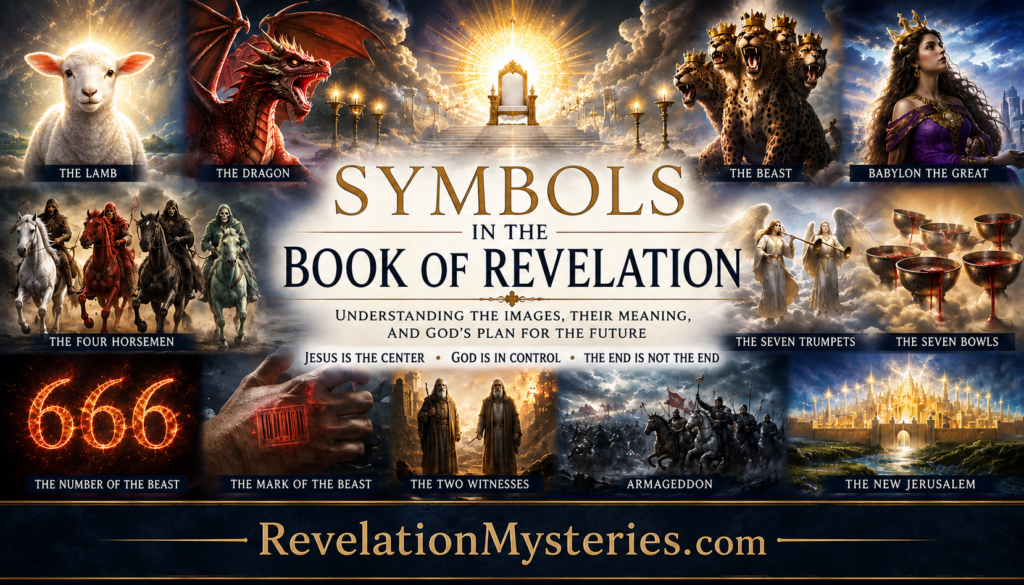
The Book of Revelation is filled with extraordinary images and symbols.
There are dragons, beasts, horns, crowns, a woman, a baby, seals, trumpets, bowls, stars, lampstands, horsemen, angels, locusts, earthquakes, Babylon, the mark of the beast, 666, a harlot, the river of life, and the tree of life. And many more.
What do all these symbols mean?
Understanding the symbolism of Revelation is one of the most important keys to understanding the book itself.
Revelation is not simply a collection of strange and mysterious visions. Its symbols communicate important truths about Jesus Christ, God's judgment, Satan, evil, spiritual warfare, God's people, the return of Christ, the defeat of evil, and God's ultimate victory.
The challenge is determining what each symbol represents and how it should be interpreted.
This guide explores the major symbols in the Book of Revelation, explains their biblical significance, and provides a framework for understanding Revelation's prophetic imagery.
Why Does Revelation Use So Many Symbols?
The Book of Revelation is written in an apocalyptic and prophetic style that uses vivid imagery to communicate spiritual and prophetic realities.
John repeatedly describes what he sees in visions.
For example, Revelation 1 describes:
- Seven golden lampstands
- Seven stars
- One like a Son of Man
- Eyes like a flame of fire
- Feet like burnished bronze
- A voice like the roar of many waters
Later chapters introduce even more dramatic imagery.
The symbolism is not accidental.
In many cases, Revelation itself explains its symbols.
For example, Revelation 1:20 explains that the seven stars represent the angels of the seven churches and the seven lampstands represent the seven churches.
This gives us an important principle:
When Revelation explains a symbol, we should pay close attention to the explanation Revelation itself provides.
We should also interpret Revelation in light of the rest of Scripture.
The Old Testament provides much of the imagery that appears throughout Revelation, especially books such as Daniel, Ezekiel, Isaiah, Zechariah, and Exodus.
How Should We Interpret Symbols in Revelation?
One of the biggest mistakes people can make when studying Revelation is assuming that every symbol has an arbitrary meaning.
A better approach is to examine the symbol within its biblical and literary context.
1. Look for Revelation's Own Explanation
When Revelation explains a symbol, that explanation should receive priority.
For example:
- The seven lampstands represent the seven churches.
- The seven stars represent the angels of the seven churches.
- The seven heads of the beast are explained in Revelation 17.
- The waters associated with Babylon are explained in Revelation 17:15.
Revelation sometimes gives us the interpretation directly.
2. Examine the Immediate Context
Ask what happens before and after the symbol appears.
What characters are involved?
What actions take place?
What consequences follow?
The surrounding passage can provide important clues.
3. Compare Scripture With Scripture
Revelation contains numerous allusions to the Old Testament.
The imagery of beasts, horns, kingdoms, judgment, plagues, heavenly beings, and God's throne frequently connects with earlier biblical passages.
Daniel is especially important for understanding Revelation's imagery of beasts and kingdoms.
4. Consider the Symbol's Repeated Use
Some symbols appear repeatedly throughout Revelation.
For example:
- Lamb
- Dragon
- Beast
- Babylon
- Seven
- Thrones
- Crowns
- Horns
- Stars
- White robes
Repeated imagery can help us understand the theological themes of the book.
5. Avoid Making Every Detail Symbolic
Not every detail necessarily represents a separate prophetic code.
Sometimes a detail contributes to the overall picture without having an independent hidden meaning.
The goal is not to decode Revelation like a secret mathematical formula.
The goal is to understand the message John was communicating.
The Most Important Symbols in the Book of Revelation
The following are among the most significant symbols and images found throughout Revelation.
1. The Lamb
One of the most important symbols in Revelation is the Lamb.
The Lamb represents Jesus Christ.
John sees the Lamb in Revelation 5 as the One who is worthy to take the scroll and open its seals.
The Lamb appears to have been slain, emphasizing Christ's sacrificial death.
This is one of the central themes of Revelation:
Jesus conquers through His sacrificial death and resurrection.
The Lamb is a powerful contrast to the violent beasts associated with evil.
Revelation's ultimate hero is not a political ruler or military conqueror.
It is the Lamb.
Related keyword cluster:
- Lamb of God in Revelation
- what does the Lamb represent in Revelation
- Jesus as the Lamb in Revelation
- Revelation 5 Lamb
- meaning of the Lamb in Revelation
2. The Dragon
The dragon is one of Revelation's clearest symbols.
Revelation 12 identifies the dragon as:
“that ancient serpent, who is called the devil and Satan.”
Therefore, the dragon represents Satan.
The dragon is portrayed as the enemy of God, God's people, and ultimately Christ.
Revelation presents a cosmic conflict between God and Satan, but the outcome is never genuinely in doubt.
Satan's apparent power is temporary.
God's victory is final.
3. The Beast
The beast is one of the most discussed symbols in the entire Book of Revelation.
Revelation describes a beast rising from the sea and exercising enormous authority.
The beast is associated with:
- Political power
- Authority
- Worship
- Opposition to God
- Persecution
- Deception
- The number 666
The beast is closely connected with the dragon.
Revelation presents the dragon as giving authority to the beast.
The symbolism has strong connections to the beasts and kingdoms described in Daniel 7.
Understanding the beast requires careful examination of Revelation 13 and Revelation 17 as well as the Old Testament background.
Related keywords:
- beast in Revelation
- beast of Revelation explained
- what does the beast represent
- Revelation 13 beast
- beast system in Revelation
- Antichrist and the beast
- meaning of the beast in Revelation
4. The False Prophet
Revelation 13 introduces another beast, later associated with the false prophet.
The false prophet performs signs and directs people toward worship of the first beast.
This figure represents religious deception and false worship aligned with the beast's authority.
Revelation therefore presents a powerful counterfeit system:
Dragon → Beast → False Prophet
This counterfeit system stands in opposition to God, Christ, and true worship.
5. The Mark of the Beast
The mark of the beast is one of the most famous symbols in Revelation.
Revelation 13 describes the mark as being associated with the beast and connected to economic activity.
The mark is also connected with allegiance and worship.
The significance of the mark must therefore be understood within the larger context of worship, loyalty, authority, and opposition to God.
It should not be isolated from the surrounding discussion of the beast.
Related keywords:
- mark of the beast
- what is the mark of the beast
- meaning of the mark of the beast
- Revelation 13 mark
- mark of the beast explained
- 666 and the mark of the beast
6. The Number 666
Few symbols in Revelation have generated as much speculation as 666.
Revelation 13:18 calls it the number of the beast.
The passage specifically tells readers that wisdom is required to calculate or understand the number.
The number therefore has an important connection with the beast.
Throughout history, interpreters have proposed numerous explanations for 666.
The safest approach is to begin with Revelation itself and its historical and biblical context rather than starting with modern speculation.
Related keywords:
- 666 meaning
- what does 666 mean in Revelation
- number of the beast
- 666 in the Bible
- Revelation 13 666
- meaning of 666
7. The Seven Churches
Revelation begins with messages to seven churches in Asia Minor.
The churches are:
- Ephesus
- Smyrna
- Pergamum
- Thyatira
- Sardis
- Philadelphia
- Laodicea
The seven churches were real churches receiving specific messages from Christ.
At the same time, the messages contain principles that continue to speak to churches and individual Christians.
The number seven also becomes an important symbolic number throughout Revelation.
8. The Seven Lampstands
The seven lampstands appear in Revelation 1.
Revelation explains that they represent the seven churches.
This is an excellent example of Revelation interpreting its own symbolism.
The lampstand imagery also connects with biblical themes of light, witness, and God's presence.
Christ is portrayed as walking among the lampstands, emphasizing His awareness of and relationship with His churches.
9. The Seven Stars
The seven stars appear in Christ's right hand in Revelation 1.
Revelation 1:20 explains their meaning.
The seven stars represent the angels of the seven churches.
The image communicates Christ's authority and His relationship to the churches.
10. The Number Seven
The number seven appears throughout Revelation.
Examples include:
- Seven churches
- Seven lampstands
- Seven stars
- Seven seals
- Seven trumpets
- Seven thunders
- Seven bowls
- Seven spirits of God
- Seven heads
- Seven mountains
Seven frequently communicates the idea of completeness or fullness in biblical symbolism.
However, the meaning of seven should still be considered in each individual context.
11. The Four Horsemen of Revelation
Revelation 6 introduces four horsemen.
They ride horses of different colors and are associated with events that unfold as the first four seals are opened.
The horsemen are commonly associated with:
- Conquest
- War
- Famine
- Death
The fourth horseman is specifically named Death, with Hades following him.
The four horsemen represent powerful forces associated with judgment and catastrophe.
Related keywords:
- four horsemen of Revelation
- Revelation four horsemen explained
- meaning of the four horsemen
- four horsemen of the Apocalypse
- Revelation 6 horsemen
12. The Seven Seals
The scroll in Revelation 5 has seven seals.
Only the Lamb is worthy to open them.
As the seals are opened in Revelation 6–8, John sees a series of events and judgments.
The seven seals form one of the major symbolic structures of Revelation.
The scroll and its seals communicate God's authority over the unfolding purposes of history.
Related keywords:
- seven seals in Revelation
- seven seals explained
- meaning of the seven seals
- Revelation 6 seven seals
- scroll with seven seals
13. The Seven Trumpets
The seven trumpets are introduced after the seventh seal.
As the angels sound the trumpets, John sees dramatic judgments involving:
- Earth
- Vegetation
- The sea
- Rivers and springs
- Heavenly bodies
- Demonic forces
- Humanity
Trumpets have significant biblical associations with warning, proclamation, warfare, gathering, and judgment.
The trumpet judgments should be studied in connection with Old Testament passages involving trumpets and divine judgment.
Related keywords:
- seven trumpets in Revelation
- seven trumpets explained
- Revelation seven trumpets meaning
- Revelation 8 trumpets
- Revelation 9 trumpets
- Revelation trumpet judgments
14. The Seven Bowls
Revelation 15–16 describes seven bowls of God's wrath.
These judgments are poured out upon the earth.
The bowl judgments are closely associated with the final stages of God's judgment against evil.
They include judgments involving:
- The earth
- The sea
- Rivers and springs
- The sun
- The throne of the beast
- The Euphrates
- A massive earthquake and hail
Related keywords:
- seven bowls of Revelation
- seven bowls explained
- bowls of God's wrath
- Revelation 16
- seven bowl judgments
15. The Woman Clothed With the Sun
Revelation 12 describes a woman clothed with the sun, with the moon under her feet and a crown of twelve stars.
She is involved in a dramatic conflict with the dragon.
The symbolism of the woman has been interpreted in different ways, and understanding her requires careful attention to Revelation 12 and its Old Testament imagery.
The passage also introduces the child who is caught up to God and the conflict between the woman and the dragon.
16. The Twelve Stars
The woman in Revelation 12 has a crown containing twelve stars.
The number twelve is frequently associated in Scripture with God's covenant people.
Examples include:
- Twelve tribes of Israel
- Twelve apostles
- Twelve foundations of the New Jerusalem
- Twelve gates of the New Jerusalem
The twelve stars therefore contribute to the rich biblical symbolism surrounding God's people.
17. The Abyss
The abyss appears several times in Revelation.
It is associated with imprisonment and demonic forces.
The abyss plays an important role in Revelation 9 and Revelation 20.
In Revelation 20, Satan is bound and thrown into the abyss for a period of time.
The imagery communicates God's authority over Satan and the forces of evil.
18. The Two Witnesses
Revelation 11 describes two witnesses who prophesy.
They are associated with:
- Prophecy
- Witness
- Miraculous signs
- Opposition
- Death
- Resurrection
- Ascension
Their identity has been interpreted in different ways throughout Christian history.
The imagery of the two witnesses also draws heavily on Old Testament themes.
Their story demonstrates that God's witness continues even in the midst of opposition.
19. The 1,260 Days
The period of 1,260 days appears in Revelation's prophetic imagery.
Related expressions include:
- Forty-two months
- Time, times, and half a time
These expressions have connections with Daniel's prophecy.
Because the same prophetic period appears in different forms, Daniel provides important background for studying these passages.
20. The Two Beasts and Their Authority
Revelation 13 presents a coordinated system of power involving the dragon and the beasts.
The imagery communicates opposition to God and the persecution and deception of humanity.
The chapter is particularly important for understanding:
- The beast
- The false prophet
- The mark
- 666
- Worship
- Economic control
- Deception
Revelation 13 should therefore be studied as a complete unit rather than treating each symbol independently.
21. Babylon the Great
Babylon the Great is one of Revelation's most important symbols.
Revelation 17–18 describes Babylon as a powerful woman associated with:
- Immorality
- Wealth
- Political power
- Luxury
- Persecution
- Deception
- Commerce
- Opposition to God
The name Babylon immediately connects Revelation with the historical Babylon of the Old Testament.
Babylon becomes a powerful symbol of organized human rebellion against God.
Related keywords:
- Babylon in Revelation
- Babylon the Great explained
- what does Babylon represent in Revelation
- Revelation 17 Babylon
- Revelation 18 Babylon
- mystery Babylon meaning
- fall of Babylon Revelation
22. The Harlot of Babylon
Revelation 17 presents Babylon as a woman described as a harlot.
She sits upon the beast and is associated with kings and nations.
Her imagery communicates spiritual unfaithfulness, corruption, luxury, and rebellion.
The contrast between Babylon and the New Jerusalem is especially significant.
Babylon represents the corrupt world system that ultimately falls.
The New Jerusalem represents God's holy dwelling and the final restoration of His people.
23. The Seven Heads
The beast in Revelation has seven heads.
Revelation 17 provides an explanation involving seven mountains and seven kings.
The imagery has generated considerable debate and requires careful attention to the historical and prophetic context of the passage.
The important point is that the heads are deliberately connected to the beast's authority and kingdom.
24. The Ten Horns
The beast also has ten horns.
Horns frequently symbolize power, strength, or authority in biblical prophetic literature.
Daniel's visions are especially important for understanding the imagery of horns.
Revelation 17 connects the ten horns with ten kings.
25. Crowns
Crowns appear throughout Revelation.
They can represent:
- Authority
- Kingship
- Victory
- Reward
The context is crucial.
The crown of the Lamb is fundamentally different from the authority claimed by the beast.
Revelation repeatedly contrasts legitimate divine authority with counterfeit earthly authority.
26. White Robes
White robes are associated with God's redeemed people.
They communicate themes such as:
- Purity
- Victory
- Righteousness
- Cleansing
- Faithfulness
Revelation 7 describes a great multitude wearing white robes.
The white robe imagery points toward the redeemed status of God's people through Christ.
27. White
The color white appears repeatedly in Revelation.
White is associated with:
- Purity
- Victory
- Righteousness
- Heavenly glory
Christ appears on a white horse in Revelation 19.
The armies of heaven are also associated with white.
White robes are given to God's people.
Again, context matters, but white consistently carries positive imagery in Revelation.
28. The White Horse
Revelation 19 describes Christ riding a white horse.
He is called:
Faithful and True.
He judges and makes war in righteousness.
The image represents Christ as the victorious King who defeats His enemies.
The white horse of Revelation 19 should not automatically be confused with the first horseman of Revelation 6.
The contexts are different.
29. The Sword
A sword appears in Revelation's imagery of judgment.
In Revelation 19, a sharp sword comes from Christ's mouth.
This striking image communicates the authority and power of Christ's word in judgment.
It also recalls biblical imagery in which God's Word is powerful and authoritative.
30. The Seven Spirits of God
The expression seven spirits of God appears in Revelation.
This phrase has generated different interpretations, including connections with the fullness of the Holy Spirit and Isaiah's imagery concerning the Spirit of God.
The number seven again communicates a sense of fullness or completeness.
This symbol should be studied in connection with its appearances in Revelation rather than interpreted in isolation.
31. The Throne of God
The throne of God is one of the central images in Revelation.
Revelation 4 presents an extraordinary vision of God's throne surrounded by worship.
The throne represents:
- God's sovereignty
- Authority
- Kingship
- Judgment
- Worship
This is crucial to understanding the entire book.
Earthly powers may appear dominant, but Revelation repeatedly brings the reader back to the throne of God.
God is ultimately in control.
32. The Sea of Glass
Before God's throne John sees something like a sea of glass, like crystal.
This extraordinary image contributes to the heavenly setting surrounding God's throne.
It creates an image of purity, majesty, brilliance, and transcendence.
33. The Four Living Creatures
Revelation 4 describes four living creatures surrounding God's throne.
They are associated with:
- Worship
- God's holiness
- Heavenly authority
- Continual praise
Their imagery connects with the living creatures described by Ezekiel and Isaiah.
34. The Twenty-Four Elders
Revelation repeatedly describes twenty-four elders around God's throne.
They worship God, fall before Him, and cast their crowns before the throne.
Their exact identity has been interpreted in different ways.
Their primary role in the narrative is unmistakable:
They worship and glorify God.
35. The Seven Thunders
Revelation 10 describes seven thunders.
John hears their voices and is instructed not to write what they said.
This is particularly fascinating because Revelation deliberately leaves part of the vision unexplained.
It reminds us that not every mystery in Revelation is revealed to us.
Some things remain hidden.
36. The Great Earthquake
Earthquakes appear repeatedly throughout Revelation.
They are associated with major moments of divine judgment and upheaval.
The imagery communicates the shaking of the established order and the terrifying reality of God's intervention in history.
37. The Sun, Moon, and Stars
Heavenly bodies frequently appear in Revelation's imagery.
The sun, moon, and stars can be affected by judgment and cosmic upheaval.
These images have strong connections with Old Testament prophetic language.
They communicate events of enormous significance and the disruption of the existing order.
38. Stars Falling From Heaven
Revelation uses dramatic imagery involving stars falling from heaven.
Stars can represent different things in different biblical contexts.
Therefore, each occurrence should be interpreted according to its immediate context rather than assuming every reference to a star has exactly the same meaning.
39. Locusts From the Abyss
Revelation 9 describes terrifying creatures resembling locusts emerging from the abyss.
Unlike ordinary locusts, these creatures are supernatural and terrifying.
The imagery has important connections with the Old Testament plague of locusts and Joel's prophetic imagery.
The passage communicates terrifying judgment and spiritual evil.
40. The Euphrates River
The Euphrates appears in Revelation 9 and Revelation 16.
It has important biblical and geographical significance.
In Revelation 16, the river is dried up in preparation for events leading toward the final conflict.
Because the Euphrates was historically associated with major empires and boundaries, its appearance carries significant biblical symbolism.
41. Armageddon
Armageddon is mentioned in Revelation 16:16.
The term has become synonymous with the final great conflict associated with the end times.
Revelation connects Armageddon with the gathering of kings for battle.
The passage should be studied carefully in its immediate context and in relation to the broader biblical teaching about the return and victory of Christ.
Related keywords:
- Armageddon in Revelation
- what is Armageddon
- battle of Armageddon
- Revelation 16 Armageddon
- Armageddon meaning
- final battle Revelation
42. The Great White Throne
Revelation 20 describes the great white throne.
Before this throne, the dead are judged.
The imagery represents the final judgment before God.
The white throne communicates the holiness, authority, and righteousness of God's judgment.
43. The Lake of Fire
The lake of fire is one of the most sobering images in Revelation.
It is associated with final judgment.
Revelation describes the devil, the beast, the false prophet, death, Hades, and those whose names are not found in the book of life in connection with the lake of fire.
The imagery communicates the final and decisive defeat of evil.
44. The Book of Life
The Book of Life appears repeatedly in Revelation.
It is associated with those who belong to God and have eternal life.
Revelation 20 emphasizes the importance of having one's name written in the Book of Life.
This image underscores the eternal significance of belonging to Christ.
45. The New Jerusalem
One of the most beautiful symbols in Revelation is the New Jerusalem.
Revelation 21 describes a magnificent city coming down from heaven.
The New Jerusalem is associated with:
- God's presence
- Holiness
- Glory
- Security
- Eternal life
- The dwelling of God with His people
The city is described with extraordinary imagery involving gold, precious stones, gates, foundations, and divine glory.
The New Jerusalem represents the culmination of God's redemptive purposes.
46. The Bride of Christ
Revelation describes the New Jerusalem as the bride of the Lamb.
The bride imagery communicates the relationship between Christ and His redeemed people.
It represents purity, covenant relationship, love, belonging, and final union with Christ.
The contrast between the harlot Babylon and the bride of the Lamb is one of the most important contrasts in Revelation.
Babylon is destroyed.
The bride is glorified.
47. The Twelve Gates
The New Jerusalem has twelve gates.
The gates are associated with the twelve tribes of Israel.
This imagery emphasizes the continuity of God's redemptive purposes and the inclusion of God's people within His eternal kingdom.
48. The Twelve Foundations
The city also has twelve foundations, associated with the names of the twelve apostles.
The twelve gates and twelve foundations together create a powerful picture connecting God's people throughout redemptive history.
49. The Tree of Life
Revelation 22 returns to the imagery of the tree of life.
The tree connects Revelation with Genesis.
In Genesis, humanity is expelled from Eden and loses access to the tree of life.
In Revelation, access to the tree of life appears again in God's restored creation.
The Bible begins with humanity in a garden and ends with God's people dwelling with Him in a restored creation.
The tree of life is therefore a powerful symbol of eternal life, restoration, blessing, and God's presence.
50. The River of the Water of Life
Revelation 22 describes a river of the water of life flowing from the throne of God and of the Lamb.
The imagery communicates life, abundance, blessing, and God's provision.
The river also connects with earlier biblical imagery concerning God's life-giving presence.
51. The Light of God's Glory
Revelation 21 describes a city that does not need the sun or moon because the glory of God gives it light.
This communicates the extraordinary reality of God's presence.
The final hope of Revelation is not merely escaping earth.
It is dwelling with God.
A Simple Way to Understand Revelation's Symbols
When studying any symbol in Revelation, ask five questions:
1. What does Revelation itself say?
Look for direct explanations.
2. Where else does this image appear in the Bible?
Look especially at the Old Testament.
3. What does the immediate context tell us?
Read the entire passage.
4. Is the symbol repeated?
Repeated imagery can reveal larger themes.
5. What is the theological message?
Ask what the symbol tells us about:
- God
- Jesus
- Satan
- Evil
- Humanity
- Judgment
- Salvation
- The church
- The return of Christ
- God's eternal kingdom
This approach is much more reliable than attempting to assign a modern meaning to every detail.
Why the Old Testament Is Essential for Understanding Revelation
One of the most important principles for studying Revelation is recognizing how deeply it is connected to the Old Testament.
Revelation's imagery frequently echoes:
Daniel
Beasts, horns, kingdoms, judgment, and the Son of Man.
Ezekiel
The throne, living creatures, heavenly visions, and prophetic imagery.
Isaiah
Judgment, Babylon, creation, salvation, and God's kingdom.
Zechariah
Lampstands, olive trees, horses, and prophetic imagery.
Exodus
Plagues, judgment, deliverance, and God's sovereignty.
Because of these connections, understanding the Old Testament can dramatically improve your understanding of Revelation.
Symbols in Revelation: A Quick Reference
| Revelation Symbol | Major Significance |
|---|---|
| Lamb | Jesus Christ |
| Dragon | Satan |
| Beast | Evil political/world power opposing God |
| False Prophet | Religious deception supporting the beast |
| 666 | Number associated with the beast |
| Mark of the Beast | Allegiance to the beast |
| Seven Lampstands | Seven churches |
| Seven Stars | Angels of the seven churches |
| Seven Seals | God's unfolding purposes and judgments |
| Four Horsemen | Forces associated with judgment |
| Seven Trumpets | Prophetic warnings and judgments |
| Seven Bowls | Final judgments of God's wrath |
| Babylon | Symbol of corrupt opposition to God |
| Harlot | Babylon's corrupting influence |
| Ten Horns | Kings/authority associated with the beast |
| White Robes | Redeemed and purified people |
| Throne | God's sovereign rule |
| Two Witnesses | Prophetic witness |
| Armageddon | Gathering for final conflict |
| Great White Throne | Final judgment |
| Lake of Fire | Final defeat/judgment of evil |
| Book of Life | Those who belong to God |
| New Jerusalem | God's eternal dwelling with His people |
| Bride of the Lamb | Redeemed people of God |
| Tree of Life | Eternal life and restoration |
| River of Life | God's life-giving provision |
Common Mistakes When Interpreting Revelation Symbols
Mistake 1: Treating Every Symbol as a Secret Code
Revelation communicates theology through imagery. Not every detail needs to be decoded into a modern event.
Mistake 2: Ignoring the Old Testament
Much of Revelation's imagery becomes clearer when compared with Daniel, Ezekiel, Isaiah, Zechariah, and Exodus.
Mistake 3: Taking Every Image Completely Literally
Revelation itself uses symbolic language extensively.
Mistake 4: Making Every Symbol Mean the Same Thing Everywhere
Symbols need to be interpreted according to context.
Mistake 5: Starting With Current Events
Current events may raise interesting questions, but they should not become the starting point for interpreting Revelation.
Begin with the biblical text.
Mistake 6: Forgetting Jesus
The Book of Revelation is ultimately about Jesus Christ.
The opening verse calls it the revelation of Jesus Christ.
The Lamb is at the center of the heavenly worship.
Christ defeats the beast.
Christ returns as King.
Christ brings judgment.
Christ establishes His eternal kingdom.
And Christ dwells with His people.
The symbols are important, but they point us toward a greater reality.
Jesus is the center of Revelation.
What Is the Main Message Behind Revelation's Symbols?
Despite all the frightening imagery in Revelation, its central message is ultimately one of hope.
God wins.
Jesus Christ is victorious.
Satan is defeated.
Evil does not have the final word.
God judges wickedness.
God preserves His people.
Christ returns.
The dead are judged.
God creates all things new.
And God's people ultimately dwell with Him.
Revelation's symbols therefore should not simply create fear or curiosity.
They should lead us toward faithfulness, perseverance, worship, holiness, hope, and confidence in Jesus Christ.
Revelation Symbols Point to the Victory of Christ
Perhaps the most important symbol in the entire book is the Lamb.
The Lamb appears to have been slain, yet He stands victorious.
This captures the paradox at the heart of the Christian message.
Jesus conquered through His death and resurrection.
The powers of evil may appear overwhelming, but Revelation reveals their ultimate defeat.
The beast does not win.
Babylon does not win.
The dragon does not win.
Death does not win.
Jesus wins.
That is ultimately what Revelation wants its readers to understand.
Frequently Asked Questions About Symbols in Revelation
What are the main symbols in the Book of Revelation?
Major symbols include the Lamb, dragon, beast, false prophet, 666, mark of the beast, seven seals, seven trumpets, seven bowls, four horsemen, Babylon, two witnesses, Armageddon, the great white throne, lake of fire, New Jerusalem, tree of life, and Book of Life.
Why does Revelation use symbols?
Revelation uses vivid prophetic and apocalyptic imagery to communicate spiritual and prophetic realities. Many of its symbols also draw upon imagery found throughout the Old Testament.
Does Revelation explain its own symbols?
Yes. In several places Revelation directly explains symbols. Revelation 1:20, for example, explains the meaning of the seven stars and seven lampstands.
What does the dragon represent in Revelation?
Revelation 12 identifies the dragon as Satan, the devil, and the ancient serpent.
What does the beast represent?
The beast represents a powerful opposition to God and is associated with authority, deception, persecution, worship, and the number 666. Its imagery also connects strongly with the beasts and kingdoms of Daniel.
What does Babylon represent in Revelation?
Babylon is presented as a powerful symbol associated with corruption, immorality, wealth, political power, deception, persecution, and rebellion against God.
What does 666 mean?
666 is identified in Revelation 13:18 as the number of the beast. Its precise interpretation has been debated throughout Christian history and should be studied in the historical, biblical, and literary context of Revelation.
What do the seven seals represent?
The seven seals belong to the scroll held by God and opened by the Lamb. Their opening reveals a sequence of events and judgments that unfold within Revelation's prophetic vision.
What do the seven trumpets represent?
The seven trumpets announce a series of dramatic judgments and warnings. Their imagery has strong connections with Old Testament trumpet and judgment themes.
What do the seven bowls represent?
The seven bowls contain judgments associated with God's wrath and represent the final stage of judgment described in Revelation 15–16.
What does the New Jerusalem represent?
The New Jerusalem represents the glorious future dwelling of God with His redeemed people. Revelation 21–22 presents it as the culmination of God's plan of redemption and restoration.
Is everything in Revelation symbolic?
Not necessarily. Revelation contains symbolic imagery, but it also refers to real people, places, events, churches, and theological realities. Each passage should be interpreted according to its context.
Final Thoughts: Understanding the Symbols in Revelation
The symbols in the Book of Revelation can seem overwhelming at first.
But when you study them carefully, patterns begin to emerge.
You see the conflict between God and Satan.
You see the opposition of evil powers.
You see God's judgment.
You see the perseverance of God's people.
You see the return of Christ.
And ultimately, you see God's victory.
The Lamb defeats the beast.
Babylon falls.
Satan is defeated.
Death is destroyed.
God makes all things new.
And God's people enter into the presence of God.
The symbols of Revelation are therefore not merely mysterious images to decode.
They are part of a larger message about Jesus Christ, God's sovereignty, judgment, redemption, and the ultimate triumph of God's kingdom.
If you want to understand the Book of Revelation more deeply, begin with the biblical text, compare Revelation with the Old Testament, pay attention to the explanations Revelation itself provides, and always keep Jesus Christ at the center.
The ultimate purpose of studying Revelation is not simply to understand its symbols. It is to understand the message of the One who is revealed through them.
Continue Studying the Book of Revelation
The seven seals are only the beginning of some of the most remarkable prophetic visions in Scripture.
Continue your study of the Book of Revelation by exploring on revelationmysteries.com:
- Revelation Explained
- Revelation Timeline
- The Seven Trumpets in Revelation
- The Seven Bowls of God’s Wrath
- The Four Horsemen of the Apocalypse
- The 144,000 in Revelation 7
- The Great Multitude in Revelation 7
- The Antichrist in Revelation
- The Beast of Revelation 13
- The Mark of the Beast
- Babylon the Great
- Armageddon
- The Second Coming of Jesus
- The Millennium
- The Great White Throne Judgment
- The New Jerusalem
- The New Heaven and New Earth
The more carefully we study Revelation in its biblical context, the more clearly we see that its ultimate purpose is not to satisfy curiosity about the future.
It is to reveal Jesus Christ and call His people to remain faithful until He comes.
Why Buy Unraveling The Mysteries of the Book Of Revelation?
The Book of Revelation is one of the most fascinating, challenging, and often misunderstood books of the Bible.
Filled with visions, symbols, prophetic events, heavenly scenes, judgments, spiritual warfare, the Antichrist, the beast, Babylon, the return of Jesus Christ, the Millennium, the final judgment, the New Jerusalem, and the new heaven and new earth, Revelation can seem overwhelming when you first begin reading it.
Unraveling The Mysteries of The Book of Revelation by Kevin Bart was written to help readers understand this remarkable book of the Bible in a clear, organized, and accessible way.
Rather than treating Revelation as an impossible mystery, this book examines its major prophecies, symbols, events, and themes while seeking to understand them in light of Scripture.
Answering All Your Questions About Revelation
Since Unraveling The Mysteries of the Book Of Revelation by Kevin Bart is a clear verse-by-verse guide to understanding end times prophecy and Revelation, it answers all of the questions people have.
If you have ever asked questions such as:
- Can the Book of Revelation be explained?
- How should Revelation be interpreted?
- Does the Book Of Revelation have a timeline?
- Who are the 144,000 in Revelation?
- What are the seven seals?
- Who are the 4 horsemen of the Apocalypse?
- What are the seven trumpets?
- What are the seven bowls of God’s wrath?
- Who is the Antichrist?
- What is the mark of the beast?
- Who are the two witnesses?
- What is Babylon in Revelation?
- When will Jesus return?
- What is the Millennium?
- What happens after the final judgment?
- What is the New Heaven & Earth and New Jerusalem?
- What does Revelation say about the end times?
- Why should I buy and read Unraveling The Mysteries of the Book Of Revelation?
then Unraveling The Mysteries of the Book of Revelation was written for you.
 Kevin Bart has been a follower of Jesus for over 40 years. Kevin has taught Bible study classes, small groups, and discipleship classes for many years. He developed Pursuing Intimacy With God(opens in new tab) Bible studies website and book after many years of seeking God and studying His word. Kevin and his wife Nancy have 3 sons and 2 precious grandchildren.
Kevin is a former business owner, and current international missions ministry leader with more than four decades of combined business and ministry experience. After building and running a successful business for 23 years, with God’s guidance and blessings, he sold his company to dedicate himself to full-time global missions.
For over 20 years, Kevin and his wife Nancy have led a self funded international missions ministry. Utilizing learned business and financial management skills, as well as knowledge and experience in travel points and miles, to date they have had more than 5o mission trips to 36 countries in the Caribbean, Central America, South America, Europe, Africa, and Asia.
After many years of studying the Bible and the Book of Revelation, and writing many Bible studies and articles, Kevin finally finished Unraveling The Mysteries of the Book Of Revelation(opens in new tab). Hopefully it will be a blessing to many people.